EU Entry/Exit System and ETIAS: The Digital Nomad's Guide to Europe's New Border Rules

What Actually Changed at Europe's Borders
The EU Entry/Exit System is live. It has been fully operational since 10 April 2026, and it records your face, fingerprints and every Schengen entry and exit in a central database. ETIAS is a different system, it has not launched, and it is not required. Nobody can legally charge you for one yet.
That distinction is the whole article. Almost every mistake we see in published guidance on this topic comes from treating EES and ETIAS as one thing. They are two separate pieces of EU border infrastructure with different purposes, different legal bases, and radically different timelines. One is already deciding whether you get stamped in. The other does not exist yet as a live service.
For a tourist doing ten days in Rome, the difference is academic. For someone who spends six months a year across Europe, hops out to Tirana or Istanbul to reset a counter, and needs to know exactly how many days they have left, the difference is the difference between a smooth entry and a five-year overstay flag.
This guide covers the whole landscape at working depth: how the system registers you, what it does to day-counting, what is genuinely known about ETIAS timing, who is exempt, and what Europe keeps on file. If the conclusion you reach is that visa-free rotation has stopped being worth the arithmetic, our comparison of Europe's digital nomad visas is the next stop. Where the honest answer is "the EU has not said," we say that instead of inventing a date.
How the Entry/Exit System Actually Works
The EES is a shared EU database that replaced manual passport stamping for non-EU nationals making short stays. According to the European Commission's Migration and Home Affairs directorate, "as of 10 April 2026, the EES replaces the stamping of passports allowing the automatic detection of overstayers," and the system operates across 29 European countries.
The rollout was not sudden. The Commission set 12 October 2025 as the start of a progressive, phased introduction, with full functionality reached on 10 April 2026. If you crossed a Schengen border during that winter window, your experience depended heavily on which crossing point you used, because different borders switched on different capabilities at different times. That phase is over, and the Commission says the EES now applies at external Schengen border crossing points. Coverage of every lane is not yet uniform: the Port of Dover and Eurotunnel confirmed in July 2026 that full biometric capture for car passengers would not switch on at their juxtaposed controls until after the summer peak.
Here is how the EU Entry/Exit System works in practice, stripped of the jargon.
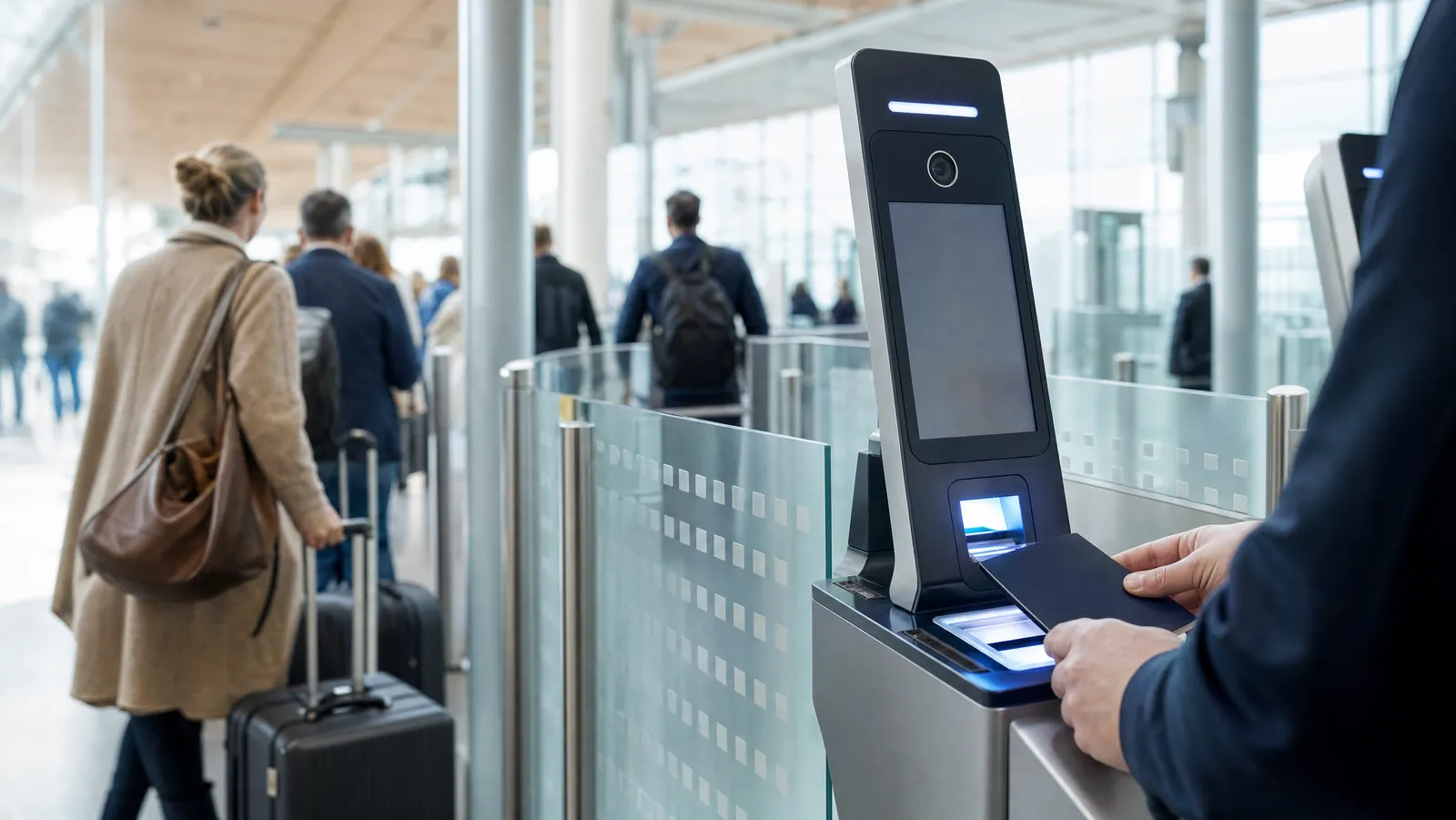
On your first crossing after registration, a border officer or a self-service kiosk captures four fingerprints and a facial image, then links them to the biographical data already in your passport chip. The Commission describes the registered dataset as "biometric data (fingerprints and captured facial images)" alongside name, travel document data, and the entry and exit dates and locations. The system also records refusals of entry.
On subsequent crossings, your biometrics are already on file, so the check is a verification rather than an enrolment. This is the part that improves over time. Your second and third crossings are meaningfully faster than your first.
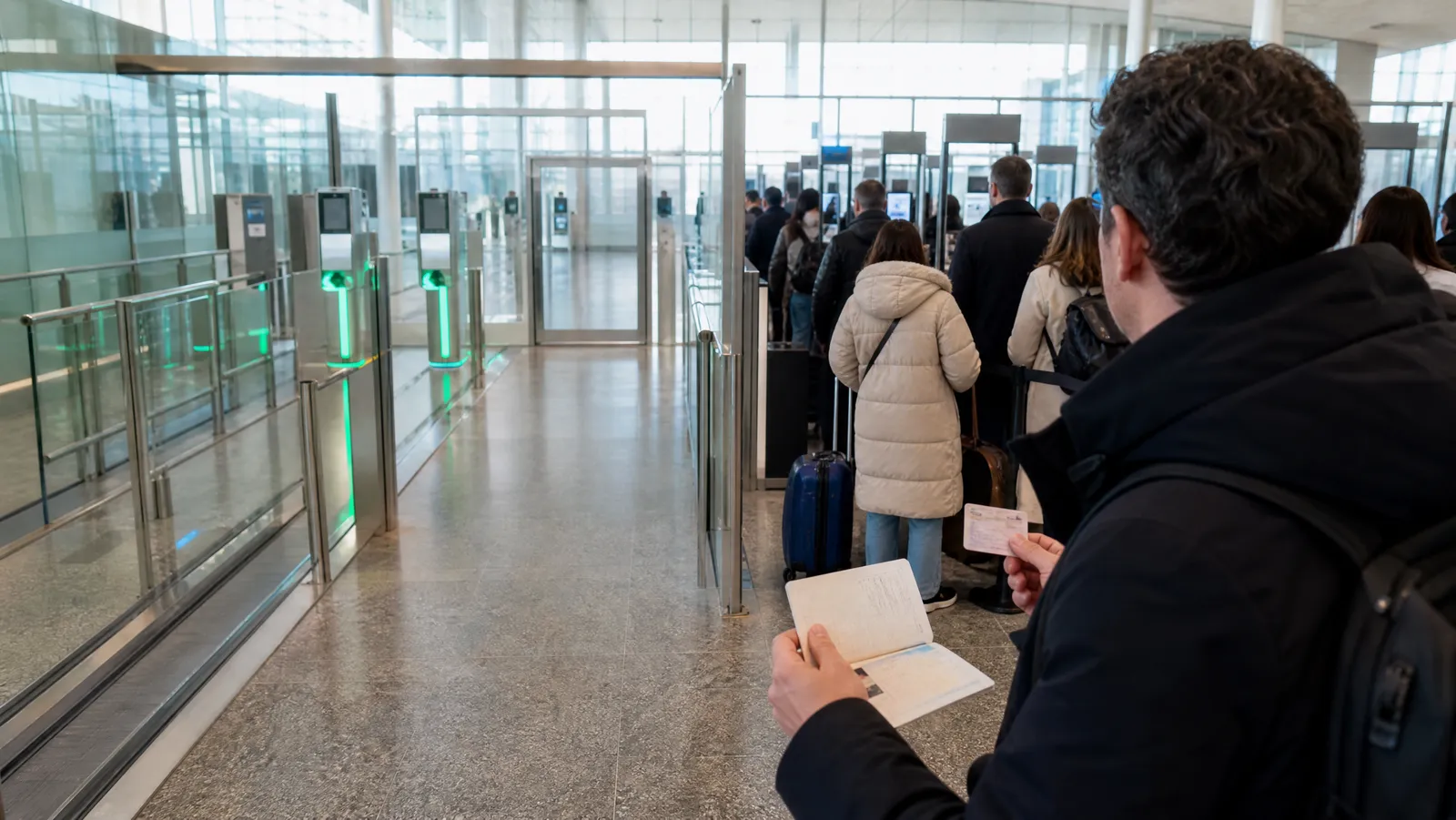
Your passport is no longer stamped. The digital record is the record. There is no ink to photograph, no smudged date to argue about, and no friendly officer who forgets to stamp you on the way out.
That last point deserves emphasis for anyone who has relied on stamp ambiguity. A missing exit stamp used to be a mildly useful accident. Under EES, a missing exit record is not ambiguity, it is an open stay that the system keeps counting.
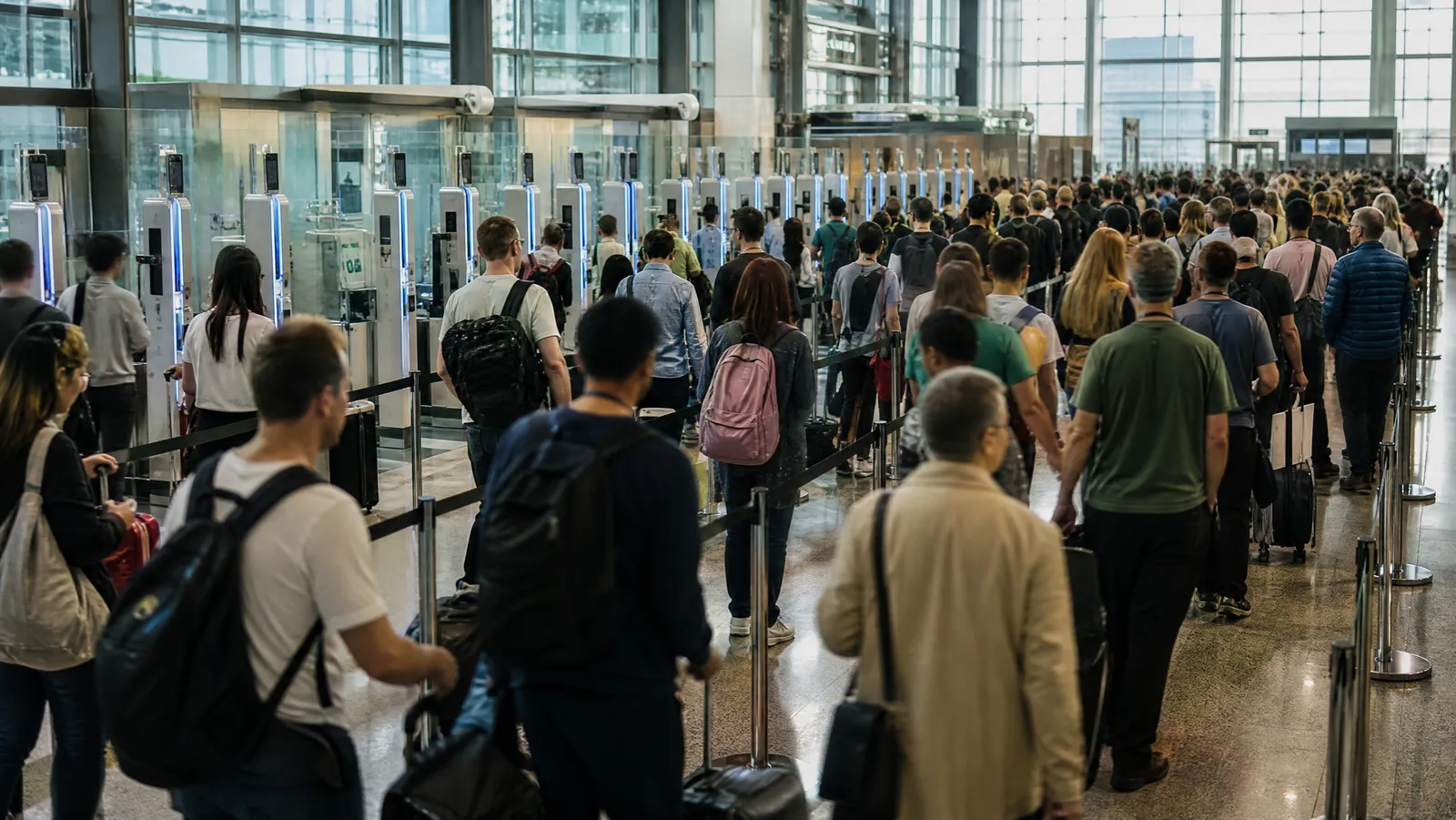
The Commission also notes that EES enables automated border control and self-service systems, which is why you will increasingly see kiosks and e-gates at large airports rather than a queue of officers with ink pads. The infrastructure is uneven. A major hub like Amsterdam or Madrid is a different experience from a land crossing in the Balkans.
ETIAS: Do You Need It Yet?
No. Not today, not as a legal requirement, and not from any website currently offering to sell you one.
We want to be precise about whether ETIAS is required yet, because this is where readers lose money. The European Commission's own ETIAS policy page states plainly that the system is "currently not in operation and no applications for travel authorisations are collected at this point." The same page says that "the European Union will inform about the specific date for the start of ETIAS several months prior to its launch."
There is no official start date. There has not been one since mid-July 2026, when the EU removed its previously published "last quarter of 2026" target from its ETIAS pages without issuing a press release or naming a replacement. That change followed Financial Times reporting that eu-LISA, the EU agency that builds and operates these systems, had concluded internally that a 2026 launch was no longer achievable. A Commission spokesperson told the FT only that "preparations for the launch of ETIAS are ongoing."
Trade press and immigration advisers now widely expect 2027, and eu-LISA's management board has been reported as due to consider a revised timetable. None of that is an announcement. We are deliberately not giving you a launch date, because the EU has not given one, and because every previous date attached to this project has moved.
What is confirmed is the shape of the thing when it does arrive:
- It is a pre-travel authorisation, not a visa. You apply online before you fly, and approval is generally near-instant for the large majority of applicants.
- The fee is set at EUR 20. The Commission raised it from the EUR 7 written into the 2018 regulation, via Commission Delegated Regulation (EU) 2025/1411 of 16 July 2025. The Commission said the new fee is set to cover the operational costs of ETIAS, taking into account all its functionalities and inflation rates; a Commission spokesperson told The Local that the figure "takes into account the rise in inflation since 2018 (the date at which the EUR 7 level was set), the additional technical functionalities added to the system, as well as the need to ensure a level playing field with similar global travel authorisation programmes." The new fee takes effect when ETIAS becomes operational, not before.
- It will not become mandatory on day one. Regulation (EU) 2018/1240 builds in a transitional period of six months from the start of operations during which "the use of ETIAS shall be optional and the requirement to be in possession of a valid travel authorisation does not apply," followed by a grace period of at least a further six months during which border authorities may exceptionally admit travellers without one, provided they otherwise meet entry conditions.
Read that third point twice. Even after ETIAS launches, there is roughly a year of runway built into the law before strict enforcement. The practical risk to nomads is not being caught without an ETIAS. It is paying a copycat website for a document that does not exist. Consumer coverage of these sites puts their typical charge at roughly EUR 50 to EUR 100 in "service fees" against an official fee of EUR 20 that nobody is collecting yet.
Our older guide to the Schengen 90/180 rule predates EES going live and still describes the older, pre-launch expectations around ETIAS. Treat this page as the current source on timing, and that one as the deeper explainer on the arithmetic itself.
What EES Means for the 90/180 Rule
The rule has not changed. Visa-free visitors still get 90 days in any rolling 180-day period across the Schengen area. What changed is that the count is now automatic, centralised, and not in your favour when you are sloppy.
Understanding how EES enforces the 90/180 rule matters more to nomads than to almost anyone else, because nomads are the people running the counter close to its limit. Three things are genuinely different now:
The arithmetic is done for you, and it is done the same way everywhere. Before EES, a border officer in Lisbon and a border officer in Tallinn were both squinting at stamps and doing mental math on a rolling window. Discrepancies were common and often resolved in the traveller's favour. Now the same database answers the question at every crossing point. The Commission's stated purpose for the system is "the automatic detection of overstayers."
Your exits count as hard data. Under the old system, the weak link was the exit stamp. Land borders in particular were inconsistent. Under EES, exits are registered as records, and Article 34 of Regulation (EU) 2017/2226 provides that where there is no exit record after the date your authorised stay expired, the data is stored for five years from that expiry date rather than the standard three. An unrecorded exit does not quietly disappear, it becomes an unresolved case.
Overstays follow you. Because the record is central and retained, a flagged overstay is visible at your next crossing regardless of which country you enter through. The old strategy of entering via a different member state does not address a centralised database.
None of this makes the rule harder. It makes it exact. If you have been running a genuinely compliant pattern, EES is neutral to mildly positive for you, because it removes the risk of an officer miscounting your stamps. If you have been running a pattern that only survived because nobody checked carefully, that pattern is over.
The practical consequence for anyone planning more than a couple of months in Europe is that the visa-free route gets less forgiving, and a proper residence permit gets more attractive. Our digital nomad visa guide covers the full landscape of options, and Europe's digital nomad visas compares the specific programmes side by side.
EES, ETIAS, UK ETA and ESTA Compared
Four systems, four purposes, and a lot of cross-contaminated advice. Here is EES and ETIAS compared with the two schemes most nomads already know.
| System | What it is | Status now | Cost | When you deal with it |
|---|---|---|---|---|
| EES (EU) | Biometric border record of entries and exits | Fully operational since 10 April 2026 | Free | At the border, every crossing |
| ETIAS (EU) | Pre-travel authorisation for visa-exempt nationals | Not in operation, no launch date announced | EUR 20 when live | Before you travel, once per multi-year validity |
| UK ETA | Pre-travel authorisation for the UK | Live | GBP 20 since 8 April 2026 | Before you travel to the UK |
| US ESTA | Pre-travel authorisation under the Visa Waiver Program | Live | USD 40 since 30 September 2025 | Before you travel to the US |
The clean mental model: ETIAS, UK ETA and ESTA are the same species. All three are cheap, online, pre-travel permissions that say "you are probably fine, come ahead." EES is a different species entirely. It is not something you apply for. It is something that happens to you at the booth.
Two practical notes on the cousins. The UK Home Office raised the ETA fee from GBP 16 to GBP 20 with effect from 8 April 2026, per its April 2026 ETA factsheet. US Customs and Border Protection increased the ESTA fee to USD 40 effective 30 September 2025, under the fee structure mandated by Public Law 119-21, with applications already paid for before that date staying at the previous USD 21.
If you are a nomad circulating between Europe, the UK and the US, you already run two of these. ETIAS will eventually be the third, at a comparable price, covering far more territory per euro than either. None of them grants the right to stay long-term or work locally, which is a separate question covered in our digital nomad visa guide.
Border Queues and Delays Since April 2026
This is the part where we decline to either panic or reassure you, because the evidence is genuinely mixed and heavily dependent on where you cross.
The headline number is that the system is working at scale. The European Commission reported on 27 July 2026 that EES had registered over 145 million entries and exits since going fully operational. That is not the profile of a system that collapsed.
The honest picture on border delays under EES is that the pain is concentrated, not uniform. Travel industry coverage through the northern summer of 2026 described longer waits at specific high-volume pinch points during peak periods, with the UK-facing crossings drawing particular attention. The Port of Dover and Eurotunnel both reported EES-related delays, and both confirmed in July 2026 that full biometric capture for car passengers would not be switched on at their terminals until after the summer peak. Ryanair's Michael O'Leary told The Times in April 2026 that the EES rollout had been "a shambles," urging member states to use the suspension options available to them rather than postponing the launch; Ryanair has since asked the Commission to extend the flexibility measures into 2027.
What we take from this, and what matches the pattern of every biometric border rollout we have watched:
- First registrations are the bottleneck, not verifications. The queue is made of people enrolling for the first time. As more of the travelling population sits in the database, throughput improves. The three-year retention period is designed around exactly this, reducing repeat enrolments.
- Land and sea crossings suffer more than airports. Airports have kiosks, e-gates and space. Coach passengers at a ferry terminal have none of those things, and a single full coach can add an hour.
- Peak season amplifies everything. August at a major hub is not a representative sample of the system's performance.
What this means for your planning. If it is your first Schengen entry since April 2026, budget an extra 45 to 90 minutes at the border, and avoid tight onward connections. Prefer an airport over a land or sea crossing for your enrolment if you have the choice. After that first registration, plan normally. We would not restructure an itinerary around EES delays in 2026, but we would not book a 55-minute layover through a first-time enrolment either. Residence permit holders skip the enrolment entirely, which is one more reason routes like Spain's digital nomad visa have got more attractive this year.
Who Is Exempt from EES and ETIAS
Plenty of people reading this are already outside the system and do not realise it. Getting this right saves you from preparing for a process you will never go through.
The Commission published a specific exemptions explainer on 27 July 2026. According to that guidance, who is exempt from EES includes:
- Nationals of Andorra, Monaco, San Marino, and holders of Vatican City / Holy See passports.
- Non-EU nationals holding a long-stay visa or a residence permit issued by a participating country, with the exception of those issued by Cyprus or Ireland.
- Non-EU family members of EU or EEA citizens who hold a residence card or permit, including spouses, children and dependent parents.
That second category is the one that matters most to this audience. If you hold a residence permit through a digital nomad visa in a Schengen country, you are outside EES for that stay. Holders of Portugal's digital nomad visa or Spain's digital nomad visa are not short-stay visitors and are not having their days counted against the 90/180 window. This is, quietly, one of the strongest practical arguments for getting a real permit rather than optimising a visa-free rotation.
Also worth knowing: EES does not cover Cyprus or Ireland. The system runs across the 29 Schengen states, which is the 25 EU members inside Schengen plus Iceland, Norway, Switzerland and Liechtenstein. Cyprus and Ireland are EU members outside the Schengen area and run their own entry procedures. ETIAS, when it launches, is expected to apply to a slightly wider group of European countries than EES does, so do not assume the two scopes are identical.
On ETIAS exemptions, the confirmed detail so far is on the fee rather than the requirement: the Commission has indicated that travellers under 18 or over 70 will be exempt from paying, though they would still need an authorisation. EU citizens and holders of residence permits do not need ETIAS at all. We will update this section against the official rules when the launch details are formally published.
Applying for ETIAS When It Launches
You cannot apply yet. When you can, the process is deliberately lightweight, and knowing the shape of it now is the best defence against the scam economy that has grown up around it.
Here is what is established about the ETIAS application and its cost:
- Where: Frontex, the EU border agency that runs the ETIAS Central Unit, describes europa.eu/etias (which resolves to travel-europe.europa.eu/etias) as "the only official ETIAS website." Frontex says it has "identified over 100 unofficial websites that currently provide information on ETIAS to non-EU travellers," notes that some use official-looking domain names and copyrighted EU material, and warns that the risks from dubious third parties "range from identity theft to charging extortionate fees and data protection concerns." Its advice is that travellers "be careful who they share their personal data with."
- Cost: EUR 20, payable to the official system. Anything materially above that is a reseller's markup, not a government fee.
- Validity: an approved authorisation is expected to run for three years, or until your passport expires, whichever comes first. This is the standard design for schemes of this type and matches the published ETIAS framework.
- What you submit: biographical details, passport data, contact and occupation information, and answers to security and health questions. No biometrics, no interview, no documents to upload in the normal case.
- Timing: approval is designed to be near-instant for most applicants, with a minority routed to manual review that can take days. Apply before you book anything non-refundable, not the night before you fly.
Our read on the copycat-site problem. Search "ETIAS" today and you will get a page of commercial domains that look official, publish confident launch dates that the EU has never committed to, and sell "assistance" for a multiple of the real fee. Some of these sites are how the 2026 misinformation spread in the first place. Their existence is a useful illustration of the problem, not a source. When ETIAS goes live, go to europa.eu/etias and nowhere else.
What to actually do between now and launch. Nothing. There is no early registration, no waitlist, and no advantage to preparation. Set a reminder to check the official page quarterly, and keep your passport valid with more than six months of runway, which you should be doing regardless. The EU has committed to announcing the start date several months in advance, so there will be warning.
Your Biometric Data: What Europe Keeps
You are handing over fingerprints and a facial image to a central EU database. It is reasonable to want to know what happens to them.
The core facts on EES biometric data and privacy come from Regulation (EU) 2017/2226, which establishes the system:
- Standard retention is three years from the date of your last recorded exit from the Schengen area. After that, the record is erased automatically.
- Retention extends to five years where no exit record follows the expiry of your authorised stay, running from the date that stay expired. Entry/exit records and refusal-of-entry records themselves are held for three years from the date of the record.
- The three-year window is deliberate, not arbitrary. EU materials explain the retention period in terms of reducing repeat enrolment, so that average border crossing and waiting times fall as the database matures. Your biometrics are on file specifically so you do not have to give them again each trip.
- The system notifies member states in advance of erasure. The regulation provides that EES automatically informs member states three months before scheduled erasure of data on overstayers, so they can act first.
You have data rights over this record. EES falls under EU data protection law, which means you can request access to your record and seek correction of inaccurate data. National authorities publish the procedure. The French interior ministry, for example, maintains a dedicated page on the processing of personal data in the EES. If you believe an exit was not registered and your day count is wrong, that is a correctable error, and it is much easier to fix before it becomes an overstay flag.
Practical habit we would adopt. Keep independent evidence of your own movements: boarding passes, the exit-side photo of your kiosk confirmation if one is offered, accommodation receipts bracketing each border crossing. Not because you expect the system to be wrong, but because if it is wrong, the burden of demonstrating otherwise falls on you, and a paper trail assembled after the fact is a worse paper trail.
Frequently Asked Questions
Is ETIAS required right now? No. The European Commission states that ETIAS is "currently not in operation and no applications for travel authorisations are collected at this point." Any site selling you one is not selling you a government authorisation.
When will ETIAS launch? The EU has not announced a date. It removed its previous "last quarter of 2026" target in July 2026 and says it will announce the start date several months in advance. Widespread expectation points to 2027, but that is expectation, not policy.
Do I need to do anything before my next trip to Europe? Only if it is your first Schengen entry since EES went fully operational. In that case, allow extra time at the border for biometric enrolment. No online form, no fee, no advance registration.
Does EES change how many days I get? No. Ninety days in any rolling 180-day period, unchanged. EES changes how precisely that is measured. The Schengen 90/180 rule explainer covers the arithmetic in detail, with the caveat that it was written before EES went live.
I have a digital nomad residence permit. Am I in EES? Generally no. Commission guidance places holders of long-stay visas and residence permits issued by participating countries outside the EES, except those issued by Cyprus or Ireland. Compare the available programmes in our digital nomad visa guide.
What happens if EES records an overstay? Where no exit was recorded after your authorised stay expired, the data is retained for five years from that expiry date rather than the standard three, and it is visible at every participating border. Consequences remain a matter for national authorities and can include refused entry or an entry ban. If the flag is a data error, pursue correction through the national data protection route immediately.
Will ETIAS and EES ever merge? They are designed to interoperate, not merge. ETIAS screens you before travel, EES records what you actually did. Expect ETIAS status to be checked against your EES record at the border once both are running.
Explore the full series
- How the EU Entry/Exit System Works: A Traveller’s Walkthrough — What actually happens at the border now that stamps are gone.
- Is ETIAS Required Yet? The Honest 2026 Status (and What Changed) — No, not yet — and here is the real timeline, minus the scare headlines.
- EES Border Queues: Which Crossings Are Slow and How to Plan Around Them — Where the biometric bottlenecks are, and how to time a crossing.
- Who Is Exempt from EES and ETIAS? Residence Permits, Visas and Dual Nationals — Long-stay visas, residence cards and dual passports change the maths.
More articles in this series publish weekly.
About the Author