The short answer
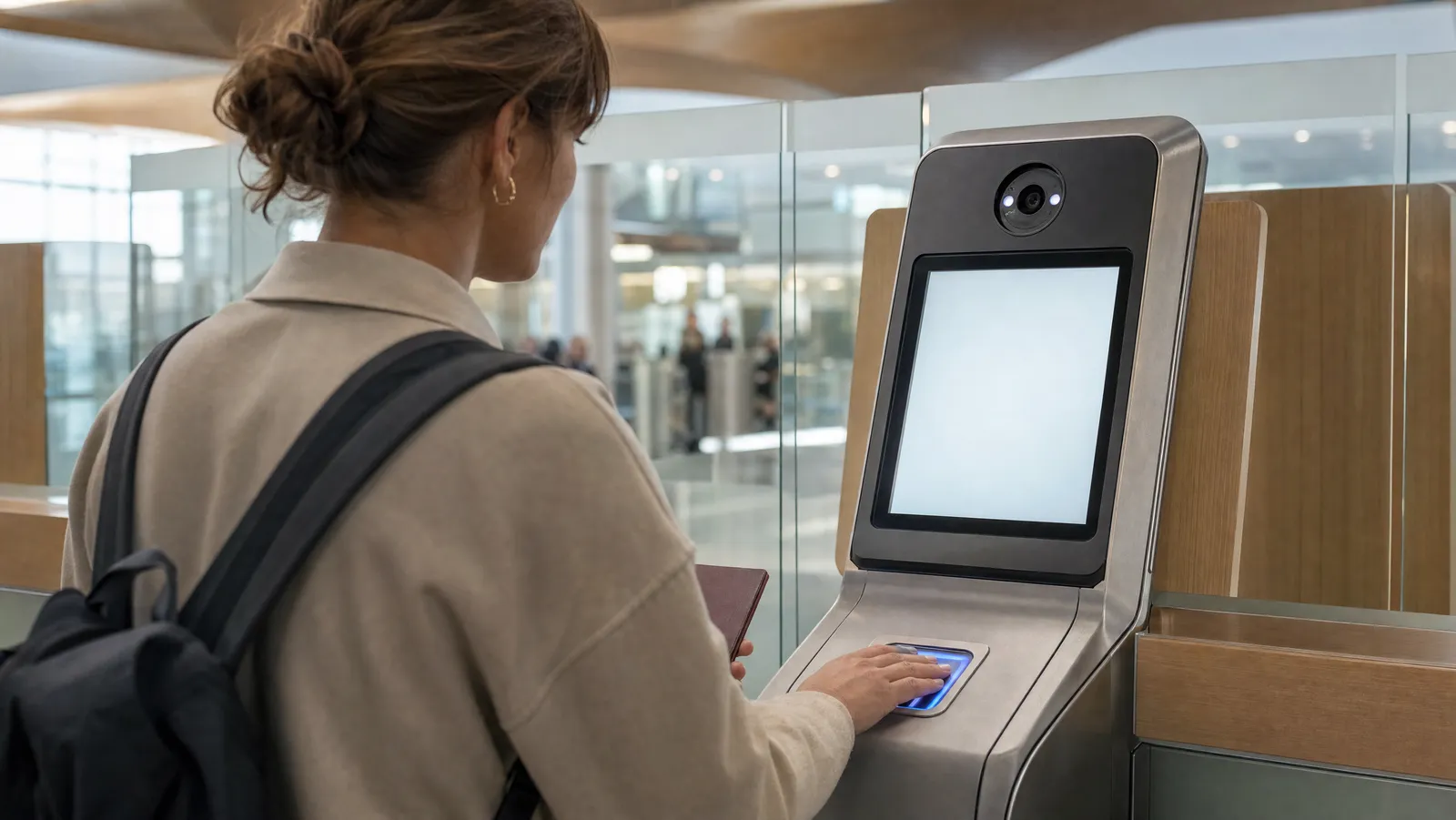
Here is how the EU Entry/Exit System works: the first time you cross a Schengen external border, officers take your fingerprints and a facial image and create a digital file linked to your passport. Every later entry and exit updates that file automatically. Your passport no longer gets stamped.
That is the whole mechanism. Everything else is detail about where it happens, how long it takes, and what the system does with the record afterwards.
Two dates matter. The European Commission confirmed that the Entry/Exit System (EES) became fully operational on 10 April 2026 at all external border crossing points of the countries using it, following a phased rollout that started on 12 October 2025. And ETIAS — the separate pre-travel authorisation people constantly confuse with EES — has not launched. More on that below, because the confusion is the single most expensive mistake you can make when planning a trip. For the wider picture, see our guide to Europe’s new border rules.
The entry/exit system, explained without the jargon
EES is a shared database. According to the European Commission, it "registers the person’s name, travel document data, biometric data (fingerprints and captured facial images) and the date and place of entry and exit," and it also records refusals of entry.
It applies to non-EU nationals travelling to the Schengen area for a short stay — up to 90 days in any 180-day period — whether or not you need a visa to get in. Americans, Britons, Canadians, Australians, Japanese and South Koreans are all in scope, and so is anyone arriving on a short-stay Schengen visa.
The system covers 29 European countries, which is the full Schengen area as it stands today. Ireland and Cyprus are EU members but are not in Schengen; they run their own border checks and still stamp passports.
The Commission is blunt about the purpose: replacing manual stamps "allows the automatic detection of overstayers (travellers who have exceeded the maximum duration of their authorised stay)." EES is not primarily a convenience upgrade. It is an enforcement upgrade that happens to be faster once you are enrolled.
One framing we have found useful: EES is the exit turnstile, not the ticket gate. It records what you did. It does not decide in advance whether you are allowed in.
How the EES entry/exit system works at the border, step by step
Your experience splits cleanly into two cases.
First crossing (enrolment). A border officer or a self-service station scans your passport, captures a facial image, and takes fingerprints. Under the rules described by the French Ministry for Europe and Foreign Affairs, the system records the travel document details, the place and time of entry and exit, and "biometric data of the traveller: facial image (photograph of the face) and, except for children under the age of 12, fingerprints." You answer the usual border questions. Then the file exists.
Every crossing after that. Your stored biometrics are matched against you, the record updates, and you move on. This is the part that is genuinely quicker than a manual stamp — once the enrolment is done.
The Commission says EES "allows a wider use of automated border control and self-service systems, which are quicker and more comfortable for the traveller." In practice, what you meet varies enormously by crossing point. Some airports have banks of self-service kiosks where you complete most of the enrolment before you reach an officer. Some have tablets handed out in the queue. Some do the whole thing at the booth, one traveller at a time. There is no single standardised entry exit system kiosk you can learn in advance, so budget time rather than expecting a specific machine.
A detail that catches people out: for travellers leaving the UK, the UK government notes that EES checks at Dover, the Eurotunnel terminal and Eurostar happen before you leave the UK, on the British side. You are enrolled in a car or a station concourse, not on arrival in France.
What the system stores, and for how long
The record is not a one-off. According to UK government guidance, digital EES records remain valid for three years, which means that within that window you do not repeat the full enrolment — return trips reuse the biometrics already on file.
What sits in the file:
- Your name and the data page of your travel document
- Facial image, and fingerprints if you are 12 or over
- The date and place of every entry and every exit
- Any refusal of entry, with the reason
Two practical consequences. First, your travel history across all 29 countries becomes a single queryable timeline rather than a scatter of ink stamps that a border officer has to find and decipher. Second, if you change passports, expect to be re-enrolled — the record is anchored to the document as well as to you.
If you refuse to give biometrics, you are refused entry. There is no opt-out lane for short-stay visitors who are in scope.
How EES changes the 90/180 calculation
This is the change that matters most to anyone spending serious time in Europe.
Before EES, the 90/180 count was reconstructed manually from passport stamps. Faint stamps, missing exit stamps and officers who simply did not stamp meant the count was frequently wrong — sometimes in your favour. That ambiguity is gone. The system now calculates your remaining days and flags an overstay at the moment you present your passport.
The rule itself has not changed. You still get 90 days in any rolling 180-day period across the whole area, and the window still rolls rather than resetting on a fixed calendar date. If you have not internalised the mechanics, our older explainer on the Schengen 90/180 rule still covers the arithmetic correctly, though it predates EES and does not reflect the biometric system.
What has changed is the margin for error. The informal tolerance some long-stay travellers relied on — a couple of days over, an unstamped entry, a sympathetic officer — depended on bad record-keeping. Assume it is gone. Our read: if you have been running close to the limit and counting on ambiguity, stop. Count precisely, and leave a buffer.
Who is exempt from EES
Not everyone crossing a Schengen external border gets registered. According to the European Commission, the exempt categories include:
- Nationals of Andorra, Monaco and San Marino, and holders of Vatican City State or Holy See passports
- Non-EU nationals holding a long-stay visa or residence permit issued by a country operating EES
- Non-EU family members of EU, EEA or Swiss citizens who hold a valid residence card or permit — spouses, children and dependent parents, for example
EU, EEA and Swiss citizens are outside the system entirely; EES exists to track third-country nationals.
If you are exempt, you still present your documents — you show the permit or card that establishes the exemption, and you are not fingerprinted or photographed for EES. If you cannot produce the qualifying document, you get registered like any other short-stay visitor. Carry the physical card.
This is worth flagging for anyone holding a national digital nomad visa or residence permit from a Schengen country: you are generally out of EES on the strength of that permit, and time in the country that issued it does not count against the 90/180 allowance. That is not a licence to roam indefinitely. Under Article 21 of the Schengen Convention, a residence permit or long-stay visa lets you move freely in the other Schengen states, but the 90-days-in-any-180 cap still applies to those other countries. The edge cases — Withdrawal Agreement Britons, dual nationals and children under 12 — are covered in our guide to who is exempt from EES and ETIAS.
The EU entry/exit system for US citizens
Americans are in scope from the first crossing, and nothing about US passport privileges changes that. The practical picture for a US citizen today:
| Question | Answer as of September 2026 |
|---|---|
| Do I need to apply for anything before flying? | No. EES has no application and no fee. |
| What happens on arrival? | Fingerprints and facial image on first entry; a biometric check thereafter. |
| Is there a cost? | None. EES is free. |
| How long can I stay? | Unchanged — 90 days in any 180-day period. |
| Do I need ETIAS? | Not yet. It has not launched. |
| Will my passport be stamped? | No. Stamping has been replaced by the digital record. |
The one operational change worth planning around is the missing stamp. If you have been using stamps as your own record of entry and exit dates, you now need to keep that log yourself. Photograph your boarding passes, or keep a simple spreadsheet of entry and exit dates. If a future border officer questions your count, the burden of explaining your own travel history is easier to carry with your own records than without.
Beware, too, of websites offering to "register" you for EES in exchange for a fee. There is no paid EES registration and no application to buy — the only official pre-registration is the EU's own free mobile app, described below, and it covers only a handful of crossings. Any site charging you is selling nothing.
The rollout has been rough, and that affects your planning
We would be doing you a disservice by describing only the design. The implementation has been genuinely painful at peak times.
The Commission reported that by 27 July 2026 the system had registered more than 145 million entries and exits since going live. At the full-operation milestone on 10 April 2026, the Commission also reported over 27,000 refusals of entry and more than 700 individuals identified as security risks during the phased rollout — the enforcement case for the system, in its own numbers.
The traveller-side numbers are less flattering. Euronews reported in July 2026 that border waits had reached up to five hours at peak periods, with Airlines for Europe, ACI Europe and IATA jointly asking for the flexibility to suspend EES during July and August, arguing the situation had "reached a critical point." Rome's airports were openly in that conversation: Euronews reported in June 2026 that the chief executive of Aeroporti di Roma said Fiumicino and Ciampino might have to let passengers skip the biometric controls to avoid a "disaster". Greece, for its part, used national flexibility to pause checks at peak times through the summer. European airports were expecting roughly 40 million more passengers in July and August than in May and June, against terminals that in some cases lack the booths, machines and staff to enrol them.
What that means concretely:
- Build in time on your first post-EES crossing, especially at a large hub in summer. Enrolment is a one-time cost, but it is a real one.
- Connections are the risk, not the arrival itself. A 60-minute layover at an EES enrolment point is optimistic.
- Off-peak and smaller crossings enrol faster. This is queue management, not policy. Our guide to EES border queues sets out which crossings are actually slow and how much buffer each one needs.
One more thing about the word "fully". The legal milestone on 10 April 2026 is real, but enforcement on the ground is still uneven. Biometric Update reported in September 2026 that nine countries — France, Germany, Italy, Belgium, the Netherlands, Greece, Malta, Portugal and Switzerland — have carried on suspending mandatory biometric capture at busy moments beyond the 6 September 2026 end of the official flexibility period, with France indicating its flexibility runs to the end of the year. So you may still be waved through without enrolment at some crossings. Treat that as luck rather than a rule: the obligation stands, and the next crossing may enrol you.
There is one official tool that may help. The EU publishes a free "Travel to Europe" mobile app that lets eligible travellers pre-register passport data and a facial image in the 72 hours before crossing, so less is done at the booth. It is voluntary, it requires a biometric passport and an NFC-capable phone, and — this is the catch — individual countries choose whether to use it, so coverage is still limited. Check whether your specific border crossing supports it before relying on it. And check the publisher before installing: the genuine app is published by the European Union and is free.
EES is not ETIAS, and ETIAS is still not required
This is where most published content on this topic goes wrong, so we will be precise.
EES is an automatic record made at the border. No application, no fee, nothing to do in advance. It is live now.
ETIAS is a pre-travel authorisation you apply for before you go, closer in kind to the US ESTA or the UK ETA. It is not in operation. The European Commission's own page states that ETIAS "is currently not in operation and no applications for travel authorisations are collected at this point," and that "the European Union will inform about the specific date for the start of ETIAS several months prior to its launch."
Read that second sentence carefully, because it is the whole story: there is no announced start date. The European Council's March 2025 indication of a launch in the "last quarter of 2026" has since been removed from the EU's own ETIAS pages, which now carry no date at all, and reporting through 2026 has pointed to 2027 as the realistic expectation rather than any committed date. We are not going to predict one, and you should treat any site that does with suspicion.
A few things that are settled about ETIAS, for when it arrives:
- The European Commission confirmed in July 2025 that the fee will be EUR 20, up from the originally legislated EUR 7, with the authorisation valid for three years. Applicants under 18 or over 70 are exempt from the fee.
- There is a phased introduction built into the law: a transitional period of roughly six months after launch during which travellers may enter without an authorisation, followed by a further grace period before it is enforced strictly on everyone.
Note that even official-adjacent guidance lags here. UK government pages have carried a line about ETIAS being "expected" from autumn 2026 — a forecast, not a commitment, and one that the EU's own pages no longer support. When the two disagree, the Commission's ETIAS page is the source of record. We track the current state in Is ETIAS Required Yet? The Honest 2026 Status (and What Changed).
The commercial risk is real. A cottage industry of lookalike sites sells ETIAS "applications" that cannot exist yet, and sells EES "registrations" that will never exist. If a site asks for money for either, close the tab.
What to do before your next Schengen crossing
A short checklist, in order of usefulness:
- Check your passport is the one you will keep using. A new passport means a new enrolment.
- Allow extra time on your first crossing since April 2026. Ninety minutes of buffer at a major hub in summer is not paranoid.
- Start your own day log. Entry and exit dates, in a note or a spreadsheet, since you will not get stamps.
- Carry your residence permit or long-stay visa if you have one — it is what keeps you out of EES and out of the 90/180 count.
- Do not buy anything. EES costs nothing and has no application. ETIAS is not open.
- Check the current ETIAS status before you book, not from a blog but from the EU's own page — the situation genuinely may change, and the honest status is the thing to verify.
The bottom line
The EU Entry/Exit System does one thing and does it thoroughly: it turns your Schengen travel history into an exact, automatically maintained record. The first crossing costs you a few extra minutes and your biometrics. Every crossing after that is faster than the stamp it replaced.
The real adjustment is not the biometrics. It is that the 90/180 rule is now enforced by arithmetic rather than by a tired officer with a stamp pad. Count your days properly, keep your own log, carry your permit if you have one, and stop looking for an ETIAS application that does not exist yet.
When ETIAS does open, the EU says you will hear about it several months in advance. Until then, the only thing standing between you and Europe is the queue.