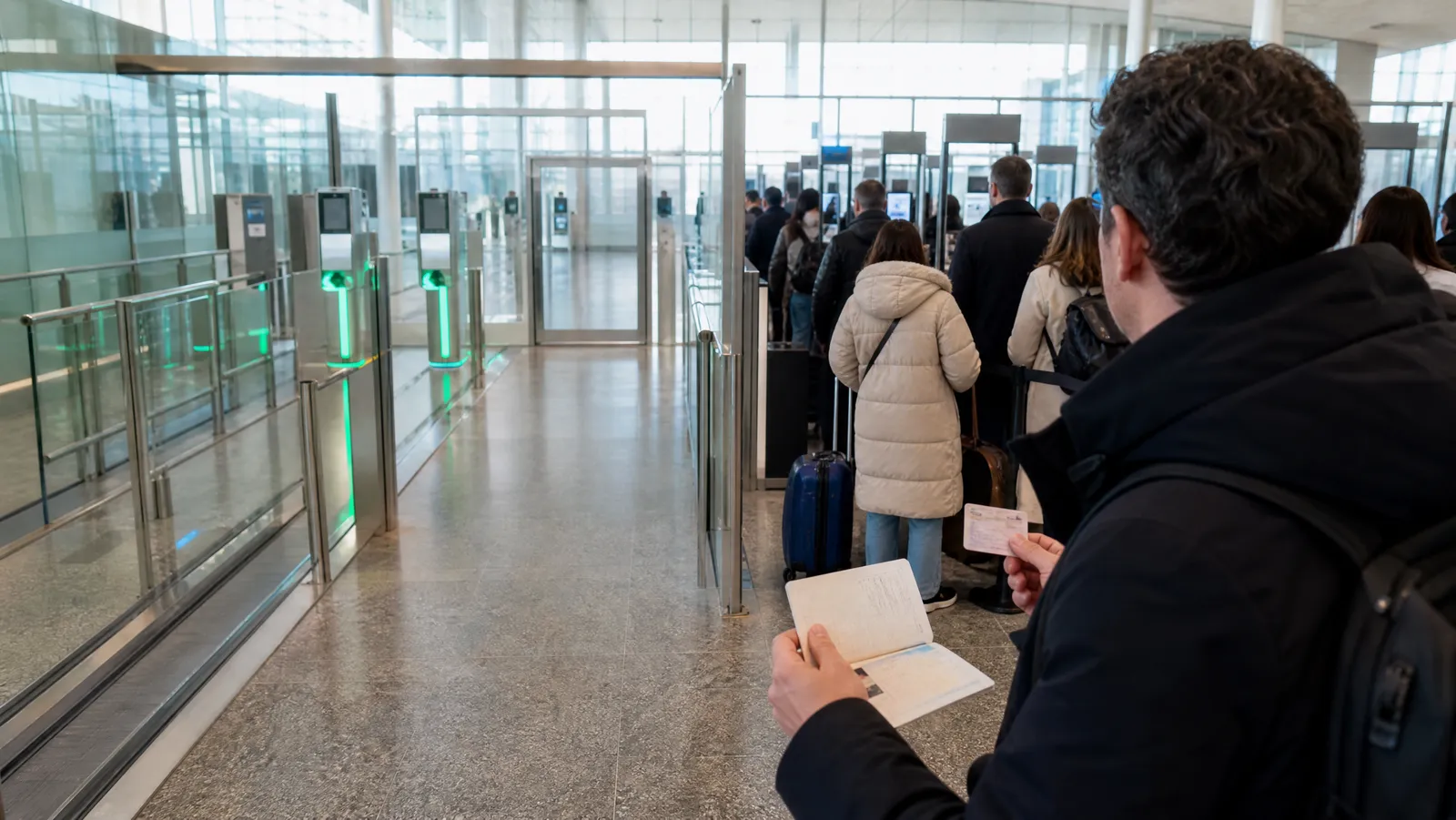
The short answer
Four groups are exempt from the EU Entry/Exit System: EU, EEA and Swiss nationals; holders of a residence permit or long-stay national visa issued by a country running EES; non-EU family members of EU citizens who hold a residence card; and nationals of Andorra, Monaco and San Marino, plus Vatican and Holy See passport holders. Everyone else in scope gets enrolled.
Who is exempt from EES is a shorter list than most travellers hope, and it is a document question far more often than a nationality question. The card in your pocket decides it. If you cannot produce the document that establishes the exemption, the exemption does not exist as far as the booth is concerned, and you are fingerprinted like any other visitor.
The European Commission has confirmed that EES has been fully operational at all external Schengen border crossing points since 10 April 2026, so none of this is theoretical any more. For the wider picture of what changed and why, start with our guide to Europe's entry and exit rules.
One warning before the detail. Being exempt from EES is not the same as being exempt from the 90/180 count, and the ETIAS exemption list is a different list again. We come back to both, because conflating them is how people get refused.
Exempt by document: residence permits and long-stay visas
This is the exemption that matters to most readers of this site.
According to the European Commission, non-EU nationals holding a long-stay visa or residence permit issued by a country operating EES are not registered in the system. That covers the national type D visa, the residence card that follows it, and every renewal after that.
The Commission is equally clear about what happens at the border, and it is undramatic: checks remain as usual. You show your passport together with the long-stay visa or residence permit, and no fingerprints or facial scan are taken.
Two traps.
The issuing country has to be an EES country. The Commission states plainly that holders of residence permits and long-stay visas issued by Cyprus or Ireland are registered in EES. Both are EU members outside Schengen, neither runs the system, and a permit from either does not buy you out of it elsewhere.
The card has to be with you, physically. A permit in a drawer in Lisbon is not an exemption. A residence card in your hand is. Photograph both sides of it too, because a card that is mid-renewal is exactly where this argument actually happens.
One more layer for anyone mid-process: in its guidance for Withdrawal Agreement beneficiaries, the Commission's EES FAQ says certain national residence permits exempt you only if the issuing state has notified them under the Schengen Borders Code and they appear in Annex 22 of the Practical Handbook for Border Guards, a list it says is regularly updated. Germany's Fiktionsbescheinigung, issued while an application is pending, is one it names.
Does a digital nomad visa exempt you from EES?
Yes, if it is a national long-stay visa or a residence permit issued by a Schengen country, which is what almost every European nomad visa is.
Portugal's D8, Spain's teleworker visa and the nomad permits issued by Greece, Italy and Croatia are type D national authorisations, not short-stay Schengen visas. On the Commission's own criterion — a long-stay visa or residence permit from a country operating EES — the holder is out of scope. We cover the programmes themselves in our complete digital nomad visa guide.
There is a gap worth naming, though.
The exemption attaches to the document, not to the approval. Between the day a consulate approves your visa and the day the residence card is physically in your hand, you may be travelling on a type D visa sticker, which does exempt you, or on a temporary national certificate, which may or may not depending on whether it is on the Annex 22 list. Spain runs a two-stage process where the visa gets you in and the TIE card follows, and our Spain digital nomad visa guide walks through it.
Our read: in the weeks around a status change, assume you will be enrolled and carry every piece of paper you have. Being registered in EES when you did not need to be is an inconvenience. Being unable to prove your status is the version that goes badly.
Family members of EU citizens
This exemption is more generous than people expect.
According to the European Commission, non-EU nationals who are family members of an EU, Icelandic, Liechtenstein, Norwegian or Swiss citizen, with spouse, child and dependent parent given as the examples, and who hold a residence card or residence permit, are exempt from EES registration "regardless of whether they are travelling with or without the family member."
Read that last clause twice. The American spouse of a Dutch citizen, holding the residence card, does not need the Dutch spouse standing beside them at the border. They can fly in alone, on their own trip, and stay outside the system.
The condition is the card. The relationship on its own does not do it, and a marriage certificate is not a residence card. Without the card you are a short-stay visitor, and you are enrolled.
UK nationals with Withdrawal Agreement status
Britons living in an EU country before the end of 2020 are the group most likely to be wrongly confident here.
The European Commission's EES FAQ is specific: UK nationals and their family members who are beneficiaries of the Withdrawal Agreement "will be exempt from registration in the Entry/Exit System (EES) only if they hold a specific residence document." The qualifying documents it lists are a valid Withdrawal Agreement residence document from the host state, a Withdrawal Agreement frontier worker document from the state of work, a special temporary Withdrawal Agreement document, or certain national residence permits.
You can identify the right card by what is printed on it. The Commission says Withdrawal Agreement residence documents are issued in the EU's uniform card format and carry a reference to Article 50 of the Treaty on European Union and Article 18 of the Withdrawal Agreement, while the frontier worker version carries "Art. 50 TEU - Frontier worker".
Three details catch people out:
- The old card does not work. The Commission states that residence documents issued to UK nationals under the Free Movement Directive before 31 December 2020 "will not exempt from registration in the Entry/Exit System", even where the host state still accepts them domestically.
- Ireland and Cyprus, again. The Commission says the exemption does not apply to Withdrawal Agreement beneficiaries whose host state is Ireland or Cyprus, since neither participates in EES.
- A certificate of application registers you but does not count against you. Holders of a certificate of application, and family members joining a beneficiary, "will be registered in the Entry/Exit System, but the system will not track whether they have left the EU in time" — the cleanest official illustration we have seen that enrolment and the overstay clock are two separate things.
There is a remedy if you were registered when you should not have been: the Commission says beneficiaries can ask to have their data deleted or amended on showing their documented status, and that all beneficiaries are entitled to apply for the document that exempts them. Do that before your next crossing, not after.
Children and the EU entry exit system
The line parents usually hear is that children under 12 do not have to give fingerprints. That is right, and it is also the most misread sentence in this whole topic.
The threshold is real. Under-12s are exempt from the fingerprint requirement, a threshold the European Parliament pushed up from the originally proposed six years. But a fingerprint exemption is not an EES exemption. Guidance on the system is consistent that a child in scope still has their travel document scanned and their facial image captured and stored.
In practice, at the booth with a nine-year-old: passport scanned, photograph taken, no fingers on the reader, and a record created. That child's entries and exits are counted like anyone else's.
So every member of the family has their own clock, and nobody gets a pass on the 90/180 arithmetic because of their age. If your children hold a different nationality from you, check their status separately rather than assuming it follows yours.
Dual nationals: the passport you hand over decides the rules
EES applies to third-country nationals, and the European Commission's position is that EU, Icelandic, Liechtenstein, Norwegian and Swiss nationals are not registered in the system at all. Put those two facts together and the dual national's question answers itself: present the EU passport and you are outside EES; present the other one and you are inside it.
If you hold Irish and Australian passports, travel on the Irish one. You use the EU lane, nothing is enrolled, and the 90/180 rule does not apply to you in the first place. Handing over the Australian passport creates a biometric record you never needed and starts a day count you are not subject to.
What we would not do is treat two passports as two allowances. We have seen no official statement inviting that reading, and a biometric system is built to identify the person rather than the booklet. Pick the stronger document and use it for both entry and exit, so your record does not end up half-finished.
It is also the long-game payoff: a nomad visa that leads to permanent residence and eventually a second passport moves you from exempt-on-a-document to exempt-by-nationality. Our guide to the residency pathway from a nomad visa covers how long that realistically takes.
Exempt from EES is not exempt from the 90/180 count
These two get treated as the same thing constantly. They are not.
EES is a recording system. The 90/180 rule is a limit. Being outside the recording system does not lift the limit, and being inside it does not create a limit that was not already there.
Where the two line up: if you hold a residence permit or long-stay visa from a Schengen country, time spent in that country is not short-stay time and does not count. That is the real prize of a national nomad visa, and why a Portuguese or Spanish permit changes the arithmetic of living in Europe.
Where they come apart: under Article 21 of the Schengen Convention, the same permit lets you travel in the other Schengen states for up to 90 days in any 180-day period, which is the ordinary short-stay cap. Your permit takes you out of enrolment across the whole area, but it does not give you unlimited time across the whole area. If the mechanics of the rolling window are not second nature yet, our explainer on the Schengen 90/180 rule has the arithmetic.
The reverse case exists too, as the certificate-of-application rule above shows: you can be registered in EES while the system is explicitly told not to run an overstay clock against you.
The honest summary is that EES changed how well the 90/180 rule is enforced, not who it applies to.
ETIAS exemptions are a separate list
Everything above is about EES. ETIAS is a different system with a different exemption list, and its status needs stating first.
ETIAS has not launched. The European Commission's own ETIAS page states that the system is currently not in operation and that no applications for travel authorisations are being collected. The European Council's March 2025 indication of a launch in the last quarter of 2026 has since been dropped from the EU's own pages, and 2026 reporting, including Financial Times coverage citing eu-LISA, the EU agency building the system, points to 2027 with no committed date. As of late September 2026 no new date has been confirmed. Any site selling you an ETIAS today is selling nothing.
When it does open, the exemptions already written into the law include holders of a valid residence permit or residence card from an ETIAS country, holders of a national long-stay visa, and holders of a uniform Schengen visa or local border traffic permit, for as long as those documents remain valid. That overlaps heavily with the EES list, so a nomad visa holder is outside both. The two lists are not identical, though, and we would not assume that a category exempting you from one exempts you from the other.
Family members of EU citizens are handled separately again, and the drafting is fiddly enough that we will not paraphrase it into false certainty. The route depends on whether you hold a residence card under the Free Movement Directive, and some family members who do have to apply have the fee waived rather than the requirement removed. Check the official ETIAS pages once the system opens.
The settled numbers, for when it happens: the Commission confirmed in July 2025 that the fee will be EUR 20, the authorisation valid for three years, with applicants under 18 or over 70 exempt from the fee. We track the live position, and the scam sites selling an application that does not exist, in is ETIAS required yet.
Frequently asked questions
Does an EES exemption mean I skip the queue?
No. The European Commission says border checks for exempt travellers remain as usual: you present your passport along with the residence permit or long-stay visa. What you skip is the biometric enrolment, not the check itself.
I have a residence permit but I was fingerprinted anyway. What now?
Show the permit and ask for the record to be corrected. The Commission's guidance on Withdrawal Agreement beneficiaries explicitly allows data to be deleted or amended on proof of status, and the same logic should apply to anyone enrolled in error. Being registered does not override the rights your permit gives you.
Is Ireland covered by any of this?
No. Ireland and Cyprus are EU members outside Schengen, they do not operate EES, and their permits do not exempt you from it elsewhere. They also still stamp passports, which the Schengen countries no longer do. For what replaced the stamp, step by step, see our walkthrough of the EES process.
The bottom line
The exemption question reduces to one sentence: the EU Entry/Exit System tracks third-country nationals making short stays, so anything that makes you not a third-country national, or not a short-stay visitor, takes you out of it. An EU passport. A residence permit. A long-stay visa. A residence card as the family member of an EU citizen. That is essentially the whole list.
Three things to do before your next crossing. Carry the physical document that establishes your exemption, not a scan on a phone that may be flat. If you hold two passports, decide which one you are travelling on and use it for both entry and exit. And keep counting your days in the other Schengen states even while exempt from enrolment, because your permit lifts the recording requirement, not the 90-day cap.
Where we would still be careful is ETIAS. Its exemption list is legislated but its launch is not scheduled, and the EU has said it will give several months of notice before the system starts. Until that notice arrives, the only correct answer to "do I need an ETIAS?" is no, and the only correct answer to "can I buy one?" is that nobody can.