Self-care for digital nomads can't depend on things you can't pack. Your gym membership doesn't travel. Your favorite bath products weigh too much. Your therapist's office is 6,000 miles away.
Yet the nomad lifestyle demands more self-care than stationary living, not less. The constant change, isolation, and uncertainty drain reserves that require intentional replenishment.
This guide covers practical self-care strategies that work anywhere—practices you can pack in a backpack and deploy in any city, any time zone, any apartment.
This is part of our complete digital nomad mental health guide.
Self-Care Beyond the Buzzword
Self-Care for Nomads
What Self-Care Actually Is
Self-care isn't bubble baths and spa days (though those are fine). It's the regular practices that maintain your physical and psychological functioning.
Self-care is:
- Sleep hygiene that supports energy
- Movement that maintains your body
- Nutrition that fuels cognition
- Boundaries that protect your time
- Connection that meets social needs
- Processing that handles emotional load
- Routines that reduce decision fatigue
Self-care isn't:
- Occasional indulgences that compensate for chronic neglect
- Something extra you add when you have time
- Optional nice-to-have
- Selfish or indulgent
The nomad lifestyle removes the passive self-care structures of stationary life (gym proximity, regular mealtimes, established routines). You must deliberately rebuild what you lost.
Why Nomads Need More Self-Care
| Nomad Reality | Self-Care Demand |
|---|---|
| Constant change | Stability through routine |
| Decision fatigue | Reduced choices via habit |
| Isolation | Intentional connection |
| Workspace blur | Boundaries via practice |
| Sleep disruption | Rigorous sleep hygiene |
| Novelty exhaustion | Recovery via familiarity |
| Identity untethering | Grounding practices |
Physical Self-Care
Your body is the foundation. When physical self-care slips, everything else follows.
Sleep
Sleep is the single highest-leverage self-care practice. Everything works better when you sleep well; everything breaks down when you don't.
Nomad sleep challenges:
- New beds constantly
- Unfamiliar sounds and environments
- Time zone adjustments
- Irregular schedules
- Poor accommodation conditions
What works:
| Strategy | Implementation |
|---|---|
| Fixed wake time | Same time every day, regardless of location or previous night |
| Sleep kit | Eye mask, earplugs, white noise app—travel with these always |
| Pre-sleep routine | Same wind-down sequence signals sleep to your body |
| Screen curfew | No screens 30-60 minutes before bed |
| Temperature | Cool room if possible; layer clothing/blankets if not |
| Caffeine cutoff | No caffeine after 2 PM (adjust based on your sensitivity) |
The 7-8 rule: Aim for 7-8 hours of sleep opportunity. Not every night will work, but consistent effort matters more than perfection.
Movement and Exercise
Exercise impacts mood, cognition, energy, and sleep. It's non-negotiable for mental health.
Nomad exercise challenges:
- No gym membership that travels
- Unfamiliar environments for running/walking
- Variable equipment access
- Travel days disrupting routine
Portable exercise options:
| Type | Implementation |
|---|---|
| Bodyweight workouts | Push-ups, squats, planks—no equipment needed |
| Walking/running | Explore new places while exercising |
| Yoga | Mat optional; apps guide anywhere |
| Resistance bands | Light, packable, add intensity |
| Hotel gym | Often free, usually adequate |
| Day passes | Local gyms often sell single-visit access |
| Outdoor fitness parks | Free in many cities |
Minimum viable exercise: 20 minutes of anything that elevates heart rate, 3-4 times per week. Walking counts. The goal is consistency, not optimization.
Apps that help:
- Nike Training Club (free bodyweight workouts)
- Yoga with Adriene (YouTube, free)
- 7 Minute Workout (science-backed minimal routine)
- Down Dog (yoga, customizable)
Nutrition
Eating well while nomading is harder than at home. No regular kitchen, unfamiliar grocery stores, abundant restaurant temptation.
Nutrition challenges:
- Irregular mealtimes
- Restaurant dependence
- Unfamiliar foods
- Accommodation without kitchen
- Budget pressure toward cheap/unhealthy options
What helps:
| Strategy | Implementation |
|---|---|
| Protein priority | Include protein at every meal for sustained energy |
| Vegetable intention | Actively choose vegetables; they're easy to skip |
| Hydration | Carry water bottle; drink before you're thirsty |
| Meal rhythm | Eat at roughly similar times daily |
| Kitchen accommodations | When possible, choose places where you can cook |
| Grocery baseline | Even in hotels, buy fruit, nuts, basic healthy snacks |
| Mindful restaurant choices | Not every meal needs to be indulgent |
The 80/20 rule: Eat reasonably well 80% of the time. Enjoy local food, occasional indulgences, and social eating the other 20%. Perfectionism isn't sustainable.
Ergonomics
Remote work often means working from bad setups that accumulate into physical problems.
Common issues:
- Laptop neck (looking down)
- Wrist strain from keyboard angle
- Back pain from poor seating
- Eye strain from screen position
Portable ergonomic solutions:
| Problem | Solution |
|---|---|
| Laptop height | Laptop stand or stack of books |
| Keyboard position | External keyboard when possible |
| Seating | Lumbar support pillow, or roll towel |
| Eye strain | Follow 20-20-20 rule (every 20 min, look 20 feet away for 20 seconds) |
| General stiffness | Stand regularly, stretch, don't sit for 8 hours straight |
See our remote work setup guide for comprehensive ergonomics.
Mental Self-Care
Your mind needs maintenance beyond physical basics.
Mindfulness Practice
Mindfulness reduces stress, improves focus, and helps regulate emotions. A daily practice compounds benefits over time.
Getting started:
- Start with 5 minutes daily
- Guided meditation is easier for beginners
- Consistency matters more than duration
- Morning often works best, but any consistent time works
Apps:
- Headspace: Structured courses, friendly interface
- Calm: Good for sleep, daily meditations
- Insight Timer: Free library of guided meditations
- Waking Up: More philosophical approach
- 10% Happier: Skeptic-friendly, practical
If you can't meditate:
- Walking meditation (mindful walking)
- Mindful coffee/tea (focus completely on the experience)
- Body scan while falling asleep
- One conscious breath before starting work
Journaling
Journaling processes experience, clarifies thinking, and provides continuity across moves.
Journaling approaches:
| Type | Method | Best For |
|---|---|---|
| Stream of consciousness | Write whatever comes for 10 minutes | Processing emotions, clearing mind |
| Gratitude | Three things you're grateful for daily | Mood improvement, perspective |
| Reflection | What happened, what you learned | Making meaning, tracking growth |
| Problem-solving | Write about a specific challenge | Clarity on decisions |
| Prompts | Answer specific questions | When blank page is overwhelming |
Making it stick:
- Same time each day (morning or evening)
- Keep journal accessible
- Don't edit yourself
- Even 3 minutes counts
- Digital or analog—whatever works
Digital Detox
Screens dominate nomad life (work, communication, entertainment, information). Regular disconnection prevents digital exhaustion.
Detox practices:
| Practice | Implementation |
|---|---|
| Screen-free morning | First 30-60 minutes without phone/laptop |
| Notification management | Batch notifications; disable most |
| Phone-free evening | Put phone away after certain hour |
| Offline day/half-day | Weekly period without internet |
| Social media boundaries | Time limits, specific checking times, or removal |
| No phone bedroom | Charge outside the bedroom |
The default question: Is this device use intentional or automatic? Intentional is fine. Automatic is where problems hide.
Learning and Growth
Novelty from travel can mask intellectual stagnation. Intentional learning provides grounded growth.
Learning practices:
- Read books (physical or digital)
- Take online courses
- Learn local language (even basics)
- Develop new skills related to work or interests
- Listen to podcasts that educate, not just entertain
The growth mindset: View challenges as learning opportunities. What is this difficult experience teaching you?
Emotional Self-Care
Emotions require processing, not just suppression.
Processing Difficult Emotions
The nomad lifestyle generates difficult emotions: grief over goodbyes, anxiety about uncertainty, loneliness despite freedom. These need to be felt, not avoided.
Processing practices:
- Name the emotion specifically ("I feel sad because...")
- Allow it without judgment ("It's okay to feel this")
- Express it somehow (journaling, talking, crying)
- Don't rush to fix it (feeling is the processing)
- Notice when it shifts (emotions are temporary)
What doesn't work:
- Suppressing ("I shouldn't feel this")
- Distracting constantly (numbing with screens/substances)
- Intellectualizing without feeling
- Comparing ("I have no right to feel bad")
Boundaries
Boundaries protect your energy and time. Without physical separation of life domains, boundaries must be explicit.
Work boundaries:
- Defined working hours
- Work-free zones or times
- Saying no to overcommitment
- Not checking email after hours
Social boundaries:
- Protecting alone time when needed
- Saying no to social invitations when depleted
- Limiting contact with draining people
- Not over-explaining your choices
Information boundaries:
- Limiting news consumption
- Curating social media carefully
- Avoiding comparison triggers
- Choosing what you pay attention to
Self-Compassion
Self-compassion is treating yourself as you would treat a good friend. Nomads often hold themselves to unrealistic standards and punish themselves for not meeting them.
Self-compassion practices:
- Talk to yourself kindly: "This is hard" not "I'm failing"
- Acknowledge common humanity: Others struggle too
- Mindfulness of suffering: Notice difficulty without exaggerating
- The friend test: Would you say this to a friend?
Self-compassion isn't:
- Making excuses for genuine problems
- Letting yourself off the hook for everything
- Feeling sorry for yourself
- Lowering standards to zero
Social Self-Care
Connection is a need, not a want.
Quality Connections
Not all social contact is equal. A meaningful conversation nourishes differently than small talk with strangers.
Quality connection markers:
- Reciprocal vulnerability
- Being truly listened to
- Shared meaning or humor
- Leaving feeling better, not drained
- Authenticity over performance
Prioritize: A few deep connections over many shallow ones. One real conversation per week matters more than daily small talk.
Solitude Balance
Solitude isn't the same as isolation. Chosen solitude recharges. Forced isolation depletes.
Healthy solitude:
- Time alone to recharge (especially for introverts)
- Space for reflection and processing
- Creative work requiring focus
- Rest without performance
Unhealthy isolation:
- Withdrawing from all connection when struggling
- Avoiding people due to anxiety or depression
- Loneliness masked as preference for solitude
- Connection attempts consistently feeling like too much effort
The test: Are you choosing alone time because it serves you, or avoiding connection because something's wrong?
For deeper strategies, see our loneliness guide.
Environmental Self-Care
Your environment affects your wellbeing. When it changes constantly, environmental self-care requires intentional attention.
Creating Sanctuary
Even in temporary accommodations, create some sense of "your space":
| Practice | Implementation |
|---|---|
| Personal items | A few objects that travel with you (photos, small items) |
| Scent | Travel candle or essential oil that signals "home" |
| Organization | Put your things in consistent places |
| Lighting | Adjust lighting for comfort (lamps, dimmers if available) |
| Sound | White noise or favorite music to create familiar soundscape |
Nature Access
Nature exposure reduces stress, improves mood, and provides perspective. Urban nomading can disconnect you from nature entirely.
Getting nature:
- Parks and green spaces in cities
- Weekend trips outside urban areas
- Walking rather than transportation when feasible
- Plants in accommodation (even small ones)
- Nature sounds or visuals when actual nature isn't accessible
Reducing Environmental Stressors
| Stressor | Solution |
|---|---|
| Noise | Earplugs, white noise app, headphones |
| Poor air quality | Air purifier, opening windows, choosing destinations |
| Cluttered space | Regular tidying, minimizing possessions |
| Uncomfortable temperature | Portable fan, layers, choosing accommodation wisely |
| Bad workspace | Day passes at coworking, finding good cafes |
Building Your Portable Routine
The ultimate self-care for nomads is a routine that travels with you.
The Morning Anchor
A consistent morning routine provides stability across all locations:
Example morning routine (30-45 minutes):
- Wake at same time (±30 minutes)
- Hydrate (glass of water immediately)
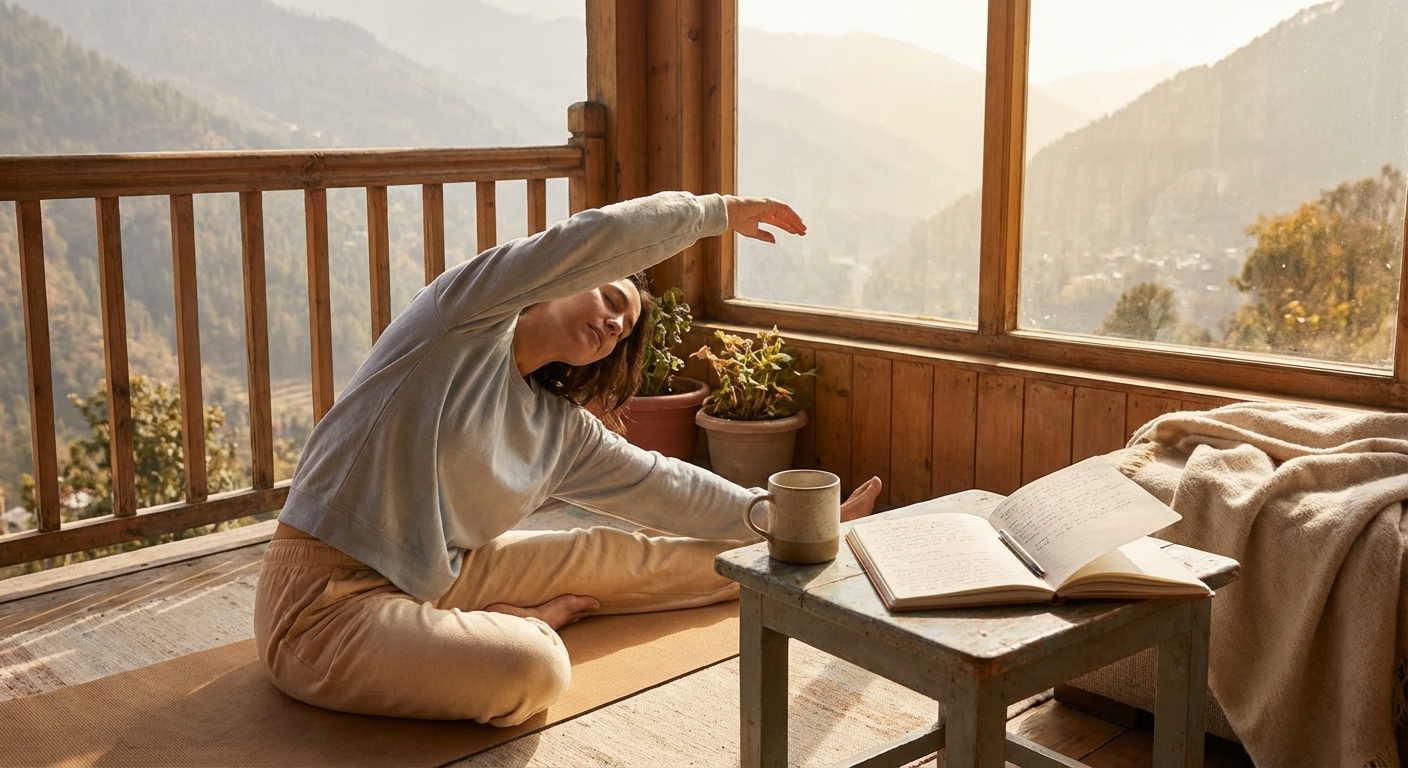
- Move (stretching, yoga, or short walk)
- Mindfulness (5-10 minutes meditation)
- Nourish (intentional, not rushed breakfast)
- Set intention (today's priorities)
Customize for you: The specific elements matter less than consistency. Build a routine you can actually do anywhere.
The Evening Wind-Down
Evening routine prepares you for sleep and provides closure:
Example evening routine (20-30 minutes):
- Work end ritual (close laptop, clear desk, define tomorrow's start)
- Screen sunset (devices away 30-60 minutes before bed)
- Reflect (journal, mental review)
- Prepare (clothes out, bag ready, reduce morning decisions)
- Wind-down activity (reading, stretching, whatever relaxes you)
- Sleep ritual (same sequence every night)
Weekly Rhythms
Beyond daily routines, weekly structure provides larger-scale stability:
| Day | Focus |
|---|---|
| Sunday | Planning week, life admin, rest |
| Monday-Friday | Work with daily self-care anchors |
| Saturday | Adventure, exploration, social |
Adjust for your work schedule and preferences, but maintain some weekly rhythm.
The Minimum Viable Self-Care
When everything falls apart—sick, moving, overwhelmed, depressed—maintain only these four:
1. Sleep Protection
Same wake time (±1 hour) regardless of what happened the night before. This anchors circadian rhythm when everything else is chaotic.
2. One Movement
Anything that moves your body. A 5-minute walk counts. The goal is any physical activity, not ideal exercise.
3. One Stillness
Even two minutes of intentional quiet. Meditation, deep breaths, sitting without devices. Brief interruption of the stress response.
4. One Connection
Reach out to one human in some way. Text, call, message. Break potential isolation. Even brief contact helps.
This floor prevents total collapse and maintains enough function to recover. Don't try to do everything when struggling—do these four things.
Self-Care Tools and Resources
Apps
| Category | Recommended Apps |
|---|---|
| Meditation | Headspace, Calm, Insight Timer, Waking Up |
| Exercise | Nike Training Club, Down Dog, 7 Minute Workout |
| Sleep | Sleep Cycle, AutoSleep, Pillow |
| Habits | Streaks, Habitica, Done |
| Journaling | Day One, Notion, physical notebook |
| Mood tracking | Daylio, Pixels, How We Feel |
Physical Items
Worth packing:
- Eye mask and earplugs
- Resistance band
- Yoga mat (thin travel version) or towel
- Water bottle
- Small journal
- Comfort item (photo, small object)
Reading
- "Atomic Habits" by James Clear (habit formation)
- "Self-Compassion" by Kristin Neff (self-compassion)
- "Why We Sleep" by Matthew Walker (sleep importance)
- "Digital Minimalism" by Cal Newport (tech boundaries)
FAQ
Frequently Asked Questions
Summary
Self-care for digital nomads requires intentionality because the lifestyle strips away passive support structures. The practices must be portable, consistent, and tied to routines rather than places.
Key principles:
- Sleep is the foundation—protect it before anything else
- Build a portable routine that anchors each day
- Cover physical, mental, emotional, social, and environmental needs
- Have a minimum viable version for difficult times
- Self-care is infrastructure, not indulgence
The nomads who thrive long-term aren't the ones who push hardest. They're the ones who sustain themselves. Self-care is how you sustain yourself.
Build the system. Maintain it. Adjust as needed. Your future self will thank you.