You're on a motorbike in Bali when a car pulls out. You wake up on the ground, tourists gathered around, sirens approaching. In the next minutes, decisions will be made about which hospital you go to, what treatment you receive, and whether your insurance will cover any of it.
Medical emergencies abroad are every nomad's nightmare scenario—but they happen. Preparation determines whether an emergency becomes a manageable crisis or a catastrophic one.
This guide covers what to do before, during, and after medical emergencies abroad. Not hypothetically—practically.
For non-emergency healthcare, see our complete healthcare guide. For insurance coverage, see our travel insurance guide.
Emergency Preparedness
Emergency Readiness Stats
What Counts as a Medical Emergency
Know the difference between urgent and emergent:
True emergencies (call ambulance/go to ER):
- Chest pain or pressure
- Difficulty breathing
- Stroke symptoms (face drooping, arm weakness, speech difficulty)
- Severe bleeding that won't stop
- Loss of consciousness
- Severe allergic reaction (anaphylaxis)
- Suspected heart attack
- Serious trauma (broken bones, head injury)
- Severe burns
- Signs of shock
- Severe abdominal pain (possible appendicitis, internal bleeding)
Urgent but not emergency (clinic within hours):
- High fever (over 103°F/39.4°C) in otherwise healthy adult
- Moderate injuries needing stitches
- Significant but non-life-threatening infection
- Severe vomiting or diarrhea (risk of dehydration)
- Eye injury or sudden vision changes
- Moderate allergic reaction
Not emergency (can wait for appointment):
- Cold/flu symptoms
- Minor injuries
- Mild pain
- Chronic condition flare-up (stable)
- Medication refills needed
Before an Emergency: Preparation
Do this work now, before you need it.
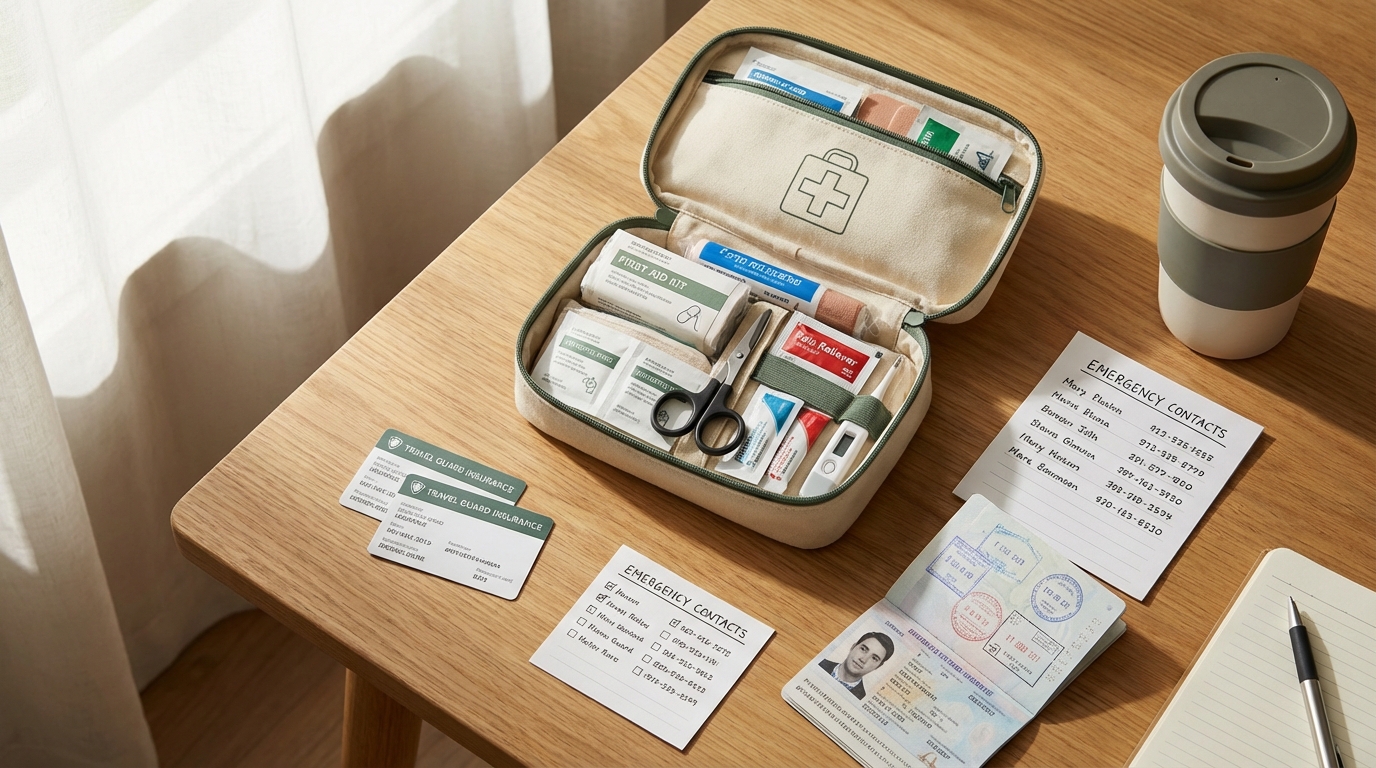
Create Your Emergency Card
Carry a card (physical and digital) with:
EMERGENCY INFORMATION

Name: [Your full legal name]
Passport: [Country] [Number]
DOB: [Date of birth]
Blood Type: [If known]

ALLERGIES:
- [List all, especially medication allergies]

MEDICATIONS:
- [Drug name] [dose] [frequency]
- [Drug name] [dose] [frequency]

CONDITIONS:
- [Any chronic conditions]

EMERGENCY CONTACTS:
Home: [Name] [Phone with country code]
Local: [Name/hotel] [Phone]

INSURANCE:
Company: [Name]
Policy #: [Number]
Emergency Line: [Phone with country code]

ICE (In Case of Emergency):
[Primary contact name and phone]
Where to keep it:
- Phone lock screen or medical ID
- Wallet (laminated)
- Carry-on bag
- Shared with travel companion
- Stored digitally (accessible offline)
Know Your Insurance Inside Out
Before an emergency, understand:
| Question | Know the Answer |
|---|---|
| What's my policy number? | Memorize or store accessible |
| 24/7 emergency number? | Save in phone, written backup |
| Do I need pre-authorization? | For non-emergency admission |
| Direct billing or reimburse? | Affects upfront cash needs |
| What's my coverage limit? | Know the maximum |
| What's excluded? | Adventure activities, pre-existing |
| Evacuation coverage? | Amount and conditions |
Save in phone:
- Insurance emergency number
- Policy number
- App installed and logged in
- PDF of policy
For detailed insurance information, see our travel insurance guide.
Research Each Destination
Before arriving somewhere new:
Find and save:
- Best hospital for emergencies
- Best hospital for serious non-emergency
- 24-hour clinic if available
- Local emergency number (not always 911)
- Nearest embassy/consulate
Store in phone:
- Addresses with GPS coordinates
- Multiple phone numbers
- Opening hours (for clinics)
Emergency Number Reference
| Country/Region | Emergency Number |
|---|---|
| Most of Europe | 112 |
| Thailand | 1669 (ambulance), 191 (police) |
| Indonesia | 118 (ambulance), 110 (police) |
| Vietnam | 115 (ambulance) |
| Japan | 119 (fire/ambulance), 110 (police) |
| Mexico | 911 |
| Colombia | 123 |
| Portugal | 112 |
| Spain | 112 |
| Australia | 000 |
| Malaysia | 999 |
During a Medical Emergency
When something happens, follow this framework.
Immediate Response (First Minutes)
Step 1: Assess and call
- If unconscious/severe: Call local emergency or have someone call
- If conscious and able: Assess if ambulance needed or taxi to hospital faster
- In some cities, taxi to hospital may be faster than waiting for ambulance
Step 2: Choose hospital if possible
- If you're conscious, direct where to go
- International hospital if available and appropriate
- Tell ambulance/taxi driver the hospital name
- If you can't choose, any ER is better than none
Step 3: Contact insurance
- Call 24/7 emergency line as soon as possible
- They can help coordinate care
- May be able to arrange direct billing
- Start claim process
Step 4: Contact someone
- Emergency contact back home
- Local contact if you have one
- Someone who can advocate for you
If Someone Else Is With You
Train travel companions on:
- Where your emergency card is
- Your insurance information
- Your medical conditions/allergies
- Who to call and in what order
- What hospitals you'd prefer
At the Hospital
Communicate clearly:
- Allergies first
- Current medications
- Medical conditions
- What happened (injury/symptoms)
- Keep it simple if language barrier
Document everything:
- Take photos of documents
- Record names of doctors/staff
- Note treatments and medications given
- Keep all receipts
- Request English translations of key documents
Regarding payment:
- Many hospitals require upfront payment or deposit
- Credit card is usually accepted
- Insurance may arrange direct billing if called early
- Pay if necessary, claim later
- Keep every receipt
Communication Challenges
If you don't speak the language:
- Google Translate app (works offline with downloaded languages)
- Point to body parts
- Use pain scale (1-10)
- Draw pictures if needed
- Ask for English-speaking staff
- Contact embassy for interpreter if critical
Useful phrases to have ready:
- "I need help" / "Emergency"
- "I have insurance"
- "I am allergic to [medication]"
- "I take this medication"
- "Please call [number]"
Medical Evacuation
Sometimes local care isn't sufficient.
When to Consider Evacuation
Evacuation may be needed when:
- Local hospital can't treat your condition
- You need surgery they can't perform
- Serious condition requires specialist unavailable locally
- Hospital quality creates risk
- You need ongoing care unavailable locally
- Your condition requires transfer to higher-level facility
Evacuation is typically NOT for:
- Minor injuries and illnesses
- Conditions local hospitals can handle
- Convenience (wanting to be home)
- After full treatment completed
How Evacuation Works
Through insurance:
- Hospital and your insurance communicate
- Medical team assesses if evacuation necessary
- Insurance approves (or denies) evacuation
- Evacuation arranged (air ambulance or commercial with medical escort)
- You're transported to appropriate facility
Cost without insurance:
- Air ambulance: $25,000-250,000+ depending on distance
- Commercial flight with medical escort: $10,000-50,000+
- This is why evacuation coverage is critical
For evacuation coverage details, see our emergency evacuation insurance guide.
Evacuation Destinations
Insurance typically covers evacuation to:
- Nearest appropriate medical facility (first priority)
- Sometimes home country
- Depends on policy wording
Note: Evacuation for convenience (wanting to recover at home after treatment complete) often isn't covered.
After the Emergency
The crisis response doesn't end at hospital discharge.
Immediate Post-Crisis
Before leaving hospital:
- Get complete medical records
- Get itemized bill
- Get diagnosis in writing
- Get prescriptions for any ongoing medications
- Understand follow-up care needed
- Get doctor contact for questions
- Clarify any activity restrictions
Insurance Claim Process
Document collection:
- All medical records
- All receipts (hospital, pharmacy, transport)
- Doctor's reports
- Police report if accident involved
- Proof of incident (photos, witness statements)
- Proof of payment
Filing the claim:
- Contact insurance with initial report (should have done during emergency)
- Complete claim forms
- Submit all documentation
- Follow up regularly
- Appeal if denied (with additional documentation)
Timeline:
- Most policies require reporting within 24-48 hours
- Claims usually due within 30-90 days
- Keep originals until claim paid
For claims process details, see our filing insurance claims guide.
Recovery Abroad
Decisions to make:
- Stay where you are and recover
- Move to better medical tourism destination
- Return home
Factors to consider:
- Quality of follow-up care available
- Cost of staying vs. traveling
- Ability to work/function
- Support network available
- Travel ability (medical clearance to fly)
Mental Health After Emergency
Medical emergencies are traumatic. Address the psychological impact:
- It's normal to feel shaken, anxious, or vulnerable
- Consider talking to a therapist (telehealth works)
- Don't rush back to "normal"
- Adjust travel plans if needed
- Talk to someone about the experience
For mental health support, see our mental health resources guide.
Emergency Kit
Build and maintain a basic emergency kit.
Essential Contents
First aid basics:
- Adhesive bandages (various sizes)
- Sterile gauze and tape
- Antiseptic wipes
- Antibiotic ointment
- Tweezers
- Small scissors
- Pain relievers (ibuprofen, acetaminophen)
- Anti-diarrheal
- Antihistamine (Benadryl)
- Oral rehydration salts
Emergency items:
- Emergency contact card (laminated)
- Insurance card copy
- Small flashlight
- Emergency whistle
- Space blanket (for shock)
Medications:
- Personal prescriptions
- EpiPen if allergies
- Rescue inhaler if asthma
- Any condition-specific emergency meds
Where to Get Supplies
Replenish kit as you travel:
- Pharmacies in major cities
- International hospitals have pharmacies
- Amazon delivers to many countries
- Carry basics from home
See our recommended first aid kit and medical ID products above, and check our toiletry essentials guide for packing tips.
Specific Emergency Scenarios
Motorbike Accident
Common nomad emergency:
At the scene:
- Don't remove helmet unless necessary for breathing
- Call for help
- Don't move if possible spinal injury
- Apply pressure to bleeding
Hospital considerations:
- Insist on imaging if head impact
- Check for internal injuries
- Document everything for insurance
- Police report often needed for claims
Note: Many travel insurance policies exclude motorbike accidents unless you have proper license. Check your policy.
Severe Food Poisoning
When to go to ER:
- Blood in vomit or stool
- Can't keep fluids down for 24+ hours
- Signs of severe dehydration
- High fever with symptoms
- Severe abdominal pain
Treatment focus:
- Rehydration (IV fluids may be needed)
- Sometimes antibiotics for bacterial infections
- Anti-nausea medication
Severe Allergic Reaction
Recognize anaphylaxis:
- Swelling of throat/face
- Difficulty breathing
- Rapid pulse
- Dizziness
- Severe hives or rash
Response:
- Use EpiPen if available
- Call emergency immediately
- Get to hospital even if EpiPen helps (can have second reaction)
Infectious Disease (Dengue, Malaria, etc.)
Warning signs:
- High fever
- Severe headache
- Joint/muscle pain
- Rash (dengue)
- Chills and sweating (malaria)
Action:
- Seek medical care promptly
- Blood test needed for diagnosis
- Dengue: supportive care, watch for severe signs
- Malaria: requires specific treatment immediately
Emergency Contacts to Save Now
Add these to your phone:
General:
- Your travel insurance emergency line
- Home country embassy in common destinations
- Your primary emergency contact
- Your doctor back home
For each destination:
- Local emergency number
- Best hospital address and phone
- Taxi number (for getting to hospital)
- Local police (if incident-related)
Taking Action Today
Don't wait until you're in crisis.
This week:
- Create your emergency card (physical and digital)
- Save insurance information to phone
- Identify emergency contacts and share plan with them
- Save this guide for offline access
Before each trip: 5. Research hospitals at destination 6. Save local emergency numbers 7. Learn basic emergency phrases 8. Brief any travel companion on your medical info
Maintain: 9. Keep emergency kit stocked 10. Review insurance coverage annually 11. Update emergency contacts as needed 12. Practice finding emergency info quickly
Nobody wants to think about medical emergencies. But 30 minutes of preparation can save your life—or at least prevent a crisis from becoming catastrophic.
Related Resources
Healthcare:
Insurance:
Mental Health: