Airbnb vs Booking.com vs Local Platforms: Which Is Best for Digital Nomads?
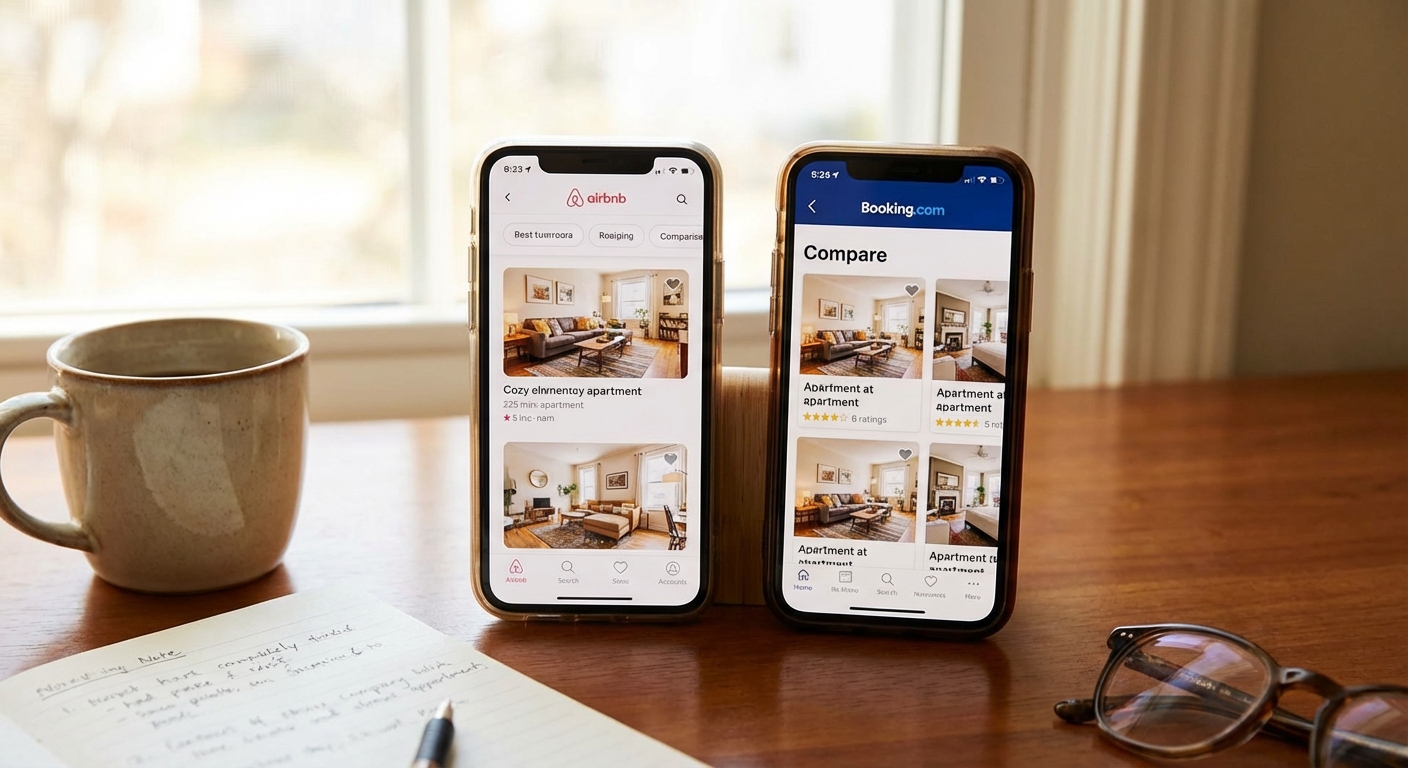

Every digital nomad eventually asks: "Should I use Airbnb, Booking.com, or just go local?" The answer depends on your destination, timeline, risk tolerance, and what you're optimizing for. This guide breaks down each platform's strengths, weaknesses, and ideal use cases so you can choose strategically rather than defaultively.
This article is part of our Complete Digital Nomad Accommodation Guide.
Platform Comparison Overview
The Global Platforms
Airbnb
Airbnb dominates the nomad accommodation conversation for good reason: global coverage, apartment-style listings, and a review system that actually works. But it's not always the best choice.
Best for:
- First visits to new cities
- Testing neighborhoods before committing
- Monthly stays (automatic 20-30% discounts)
- Unique properties (treehouse, boat, villa)
- English-speaking host communication
Limitations:
- Service fees add 14-20% to listed prices
- Banned or restricted in some cities (Barcelona, NYC, Japan)
- Quality varies wildly within same price range
- Some hosts target tourists with inflated rates
- Cancellation policies can be strict
Pro tips for Airbnb:
- Filter by "monthly stays" to see only listings offering monthly discounts
- Check review recency—a listing with 50 reviews from 2023 tells you less than 10 reviews from 2026
- Message before booking to verify wifi speeds, workspace setup, and neighborhood noise
- Superhost status matters less than specific reviews about remote work suitability
- Book first month at higher rate, then negotiate extension directly with host for 10-15% additional savings
Booking.com
Originally for hotels, Booking.com has expanded into apartments and extended stays. It's often overlooked by nomads but excels in specific situations.
Best for:
- Last-minute bookings (same-day availability)
- Maximum cancellation flexibility
- Hotel-apartment hybrids with reception/service
- Cities with limited Airbnb (Japan, certain EU cities)
- Loyalty program benefits (Genius discounts)
Limitations:
- Smaller apartment inventory than Airbnb
- Reviews less detailed about work suitability
- Can't easily message hosts before booking
- Monthly discount options less transparent
- Primarily hotel-focused in many regions
Pro tips for Booking.com:
- Use "Apartments" filter to exclude hotels
- Sort by "Homes & Apartments First" to find long-stay options
- Look for "Free cancellation" listings for maximum flexibility
- Genius Level 2+ unlocks significant discounts (10-15%)
- Check "Extended stay" tab where available for monthly rates
Which Global Platform When?
| Scenario | Best Choice | Why |
|---|---|---|
| First time in new country | Airbnb | Reviews, photos, messaging |
| Testing neighborhood 1-2 weeks | Either | Both work well |
| Monthly stay, known area | Airbnb | Automatic monthly discounts |
| Last-minute travel | Booking.com | Better same-day inventory |
| Uncertain dates, need flexibility | Booking.com | Free cancellation common |
| Japan | Booking.com | Airbnb heavily restricted |
| Spain (Barcelona, Madrid) | Booking.com or local | Airbnb restrictions increasing |
Regional Local Platforms
Local platforms offer 20-50% savings over global alternatives but require more due diligence. Google Translate (browser extension or app) makes navigating foreign-language platforms straightforward. Here's what works where.
Southeast Asia
Thailand:
- DDProperty (ddproperty.com): Largest Thai property portal
- Renthub (renthub.in.th): Condos and apartments
- Facebook Groups: "Bangkok Expats," "Chiang Mai Expats," "Phuket Apartments"
For Thailand-specific housing, see our Chiang Mai guide and Bangkok guide.
Indonesia (Bali):
- Rumah123 (rumah123.com): Indonesian property portal
- Facebook Groups: "Bali Expats & Long Termers," "Bali Canggu Community"
- Local agents: Walk Canggu/Ubud for "For Rent" signs, contact directly via WhatsApp
For Bali-specific housing, see our Bali guide.
Vietnam:
- Batdongsan (batdongsan.com.vn): Vietnamese property portal
- Chotot (chotot.com): Classifieds including rentals
- Facebook Groups: "Hanoi Expats," "Saigon Expats"
Europe
Portugal:
- Idealista (idealista.pt): Dominant Iberian platform
- OLX (olx.pt): Classifieds with rental section
- Imovirtual (imovirtual.com): Property-focused
- Note: NIF (tax ID) often required for formal contracts
For Portugal documentation, see our Portugal visa guide.
Spain:
- Idealista (idealista.com): Market leader
- Fotocasa (fotocasa.es): Strong in Barcelona/Madrid
- Habitaclia (habitaclia.com): Catalunya focus
For Spain documentation, see our Spain visa guide.
Germany:
- ImmobilienScout24 (immobilienscout24.de): Largest platform
- WG-Gesucht (wg-gesucht.de): Shared apartments (WG)
- Note: Schufa (credit score) often required—difficult for newcomers
Georgia:
- SS.ge (ss.ge): Dominant Georgian platform
- MyHome.ge (myhome.ge): Property listings
- Note: Cash-heavy market, negotiation expected
For Georgia-specific housing, see our Tbilisi guide.
Americas
Mexico:
- Inmuebles24 (inmuebles24.com): Largest Mexican platform
- Segundamano (segundamano.mx): Classifieds
- Facebook Groups: "Mexico City Expats," "CDMX Rentals"
- Note: Peso pricing (MXN) beats USD listings by 20-40%
For Mexico-specific housing, see our Mexico City guide.
Colombia:
- Fincaraiz (fincaraiz.com.co): Largest Colombian platform
- Metrocuadrado (metrocuadrado.com): Strong in major cities
- Note: Estratificación (1-6 strata) affects utility pricing
For Colombia-specific housing, see our Medellín guide.
Argentina:
- Zonaprop (zonaprop.com.ar): Property portal
- Argenprop (argenprop.com): Alternative listings
- Note: USD cash market exists alongside peso listings
Facebook Groups Strategy
Facebook Groups deserve special attention because they're simultaneously the best source of deals and the highest scam risk.
How to Use Facebook Groups Effectively
Finding groups:
- Search "[City] Expats" or "[City] Digital Nomads"
- Look for "[City] Apartments" or "[City] Rentals"
- Check group member counts (10,000+ indicates active community)
- Verify group has active moderation
Best practices:
- Join groups 4-6 weeks before arrival to observe posting patterns
- Search existing posts before asking—most questions are answered
- Post your requirements clearly: dates, budget, neighborhood preferences, workspace needs
- Verify posters: check profile age, posting history, mutual connections
- Use PayPal Goods & Services for deposits—never bank transfer or crypto
Red flags in Facebook listings:
- New profile with few posts/friends
- Refusing video calls of property
- Requesting wire transfer or Western Union
- Price significantly below market
- Pressure to decide immediately
Going Deeper
For comprehensive scam protection including verification checklists, see our Rental Scam Avoidance guide.
Platform Comparison by Factor
Price Comparison
| Platform Type | Relative Cost | Monthly Savings vs Airbnb |
|---|---|---|
| Airbnb (short-term) | Baseline (highest) | — |
| Airbnb (monthly) | -20-30% | Baseline monthly |
| Booking.com | Similar to Airbnb | ±10% |
| Local platforms | -20-40% vs monthly Airbnb | 20-40% |
| Facebook direct | -30-50% vs monthly Airbnb | 30-50% |
Safety/Protection
| Platform | Payment Protection | Dispute Resolution | Scam Risk |
|---|---|---|---|
| Airbnb | Strong | Good | Low |
| Booking.com | Strong | Good | Low |
| Local platforms | Varies | Limited | Medium |
| Facebook Groups | None | None | High |
Flexibility
| Platform | Cancellation | Modification | Last-Minute |
|---|---|---|---|
| Airbnb | Varies by listing | Usually flexible | Good |
| Booking.com | Often free | Very flexible | Excellent |
| Local platforms | Depends on contract | Negotiable | Limited |
| Negotiable | Negotiable | Variable |
Communication Quality
| Platform | Pre-booking Contact | Response Speed | Language |
|---|---|---|---|
| Airbnb | Easy messaging | Usually under 24hr | Often English |
| Booking.com | Limited | Variable | English available |
| Local platforms | Direct contact | Variable | Local language often |
| Direct contact | Variable | Mixed |
The Strategic Approach
The smartest nomads don't pick one platform—they use different platforms for different phases.
Phase 1: Discovery (Weeks 1-4)
Use: Airbnb or Booking.com
Why: Safety, reviews, predictable quality. Pay the premium for verified listings while learning the city.
Focus: Testing neighborhoods, identifying where you want to stay longer, meeting locals.
Phase 2: Optimization (Month 2+)
Use: Local platforms, Facebook Groups, direct contact
Why: Now you understand the market, know fair prices, and can evaluate listings in person.
Focus: Finding better value, negotiating monthly rates, building landlord relationships.
Phase 3: Return Visits
Use: Direct re-booking with previous landlords
Why: Established relationship = better rates, priority booking, personalized service.
Focus: Maintaining network of reliable accommodations across your regular destinations.
Platform Quick Reference
Use Airbnb When:
- First time visiting a destination
- Need verified reviews and photos
- Want messaging with hosts before booking
- Staying 28+ days (monthly discounts)
- Prioritizing convenience over cost
Use Booking.com When:
- Need maximum cancellation flexibility
- Booking last-minute
- Destination has limited Airbnb (Japan, restricted EU cities)
- Prefer hotel-style service with apartment space
- Have Genius loyalty status
Use Local Platforms When:
- Staying 2+ months in one location
- Already know the neighborhood
- Comfortable with local language or translation tools
- Want significant cost savings
- Can verify listings in person
Use Facebook Groups When:
- Looking for long-term rentals (3+ months)
- Want community-vetted recommendations
- Comfortable with higher due diligence requirements
- Can use protected payment methods
- Have time to research before arrival
Conclusion
No platform is universally "best." Airbnb offers safety and convenience at premium prices. Booking.com provides flexibility and hotel-style service. Local platforms deliver value requiring more effort. Facebook Groups enable direct deals demanding careful verification.
The strategic nomad uses all of them, matching platform to situation. Start safe with global platforms, graduate to local options as you gain experience, and eventually build a network of direct landlord relationships that bypass platforms entirely.
For the complete accommodation strategy, see our Digital Nomad Accommodation Guide.
About the Author