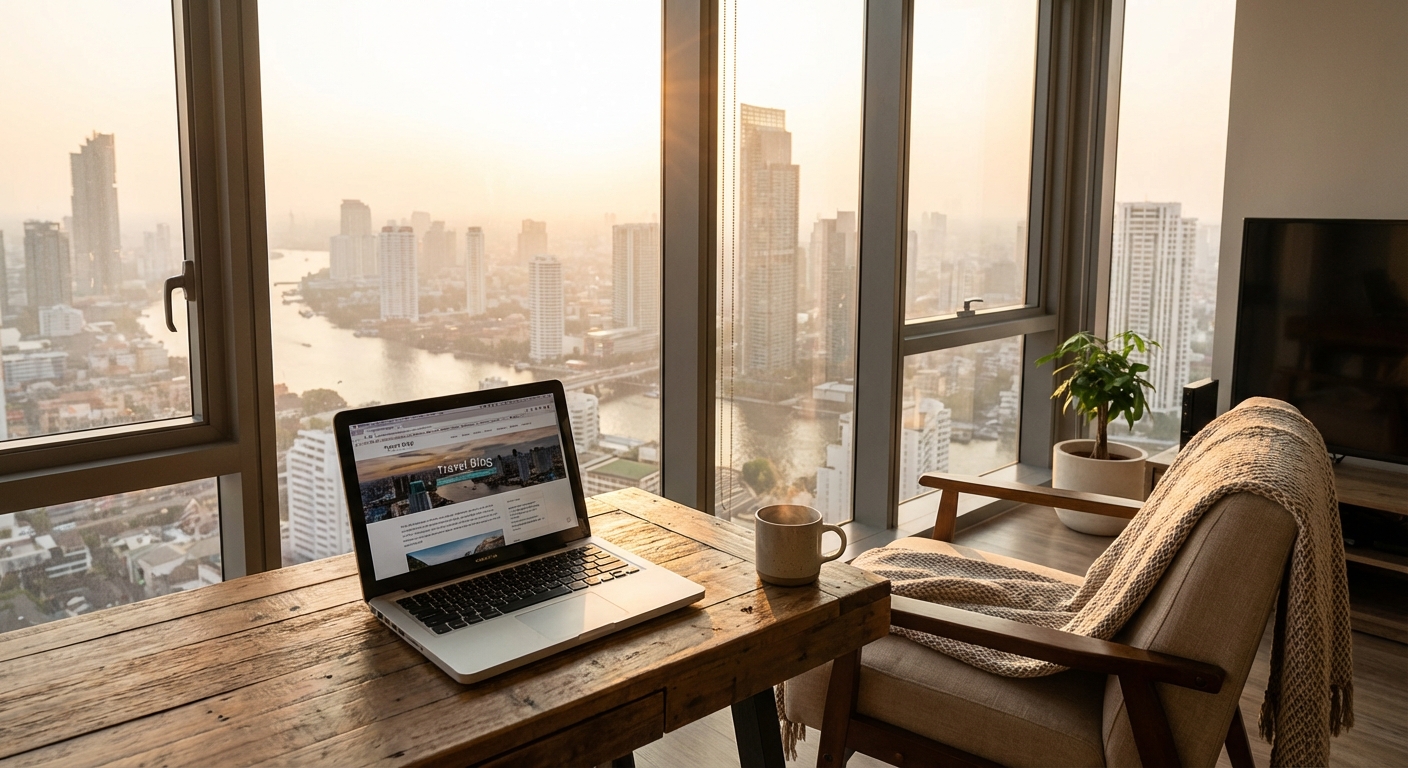
Housing consumes 40-60% of most digital nomad budgets, yet it receives less attention than visa guides or packing lists. Finding good accommodation in a foreign country where you don't speak the language, don't know the neighborhoods, and can't verify listings in person—that's the real challenge of this lifestyle.
This guide covers everything you need to know about finding, vetting, negotiating, and securing accommodation as a digital nomad. Whether you're booking your first month abroad or optimizing a long-term rotation strategy, this is your comprehensive resource.
Digital Nomad Accommodation Quick Reference
In this guide:
- Housing Types for Nomads
- Platform Overview
- Regional Differences
- The Rental Timeline
- Scam Red Flags
- Negotiation Basics
- Furnished vs Unfurnished
- Work-From-Home Considerations
- Utilities and Deposits
- FAQ
Housing Types for Nomads
Different housing types serve different phases of the nomad journey. Understanding what each offers helps you match accommodation to your current needs.
Short-Term Options (1-4 Weeks)
| Type | Best For | Budget (Monthly Equivalent) |
|---|---|---|
| Airbnb/VRBO | Arriving in new cities, testing neighborhoods | $1,000-2,500+ |
| Hotels | Short business trips, initial landing | $1,500-4,000+ |
| Hostels | Budget travelers, social atmosphere | $400-800 |
| Booking.com apartments | Extended hotel-style stays | $800-2,000 |
Short-term rentals provide flexibility and safety—you can see exactly what you're booking, reviews are recent, and you're not locked into long commitments. The trade-off is cost: premium pricing for convenience.
Medium-Term Options (1-3 Months)
| Type | Best For | Budget (Monthly) |
|---|---|---|
| Monthly Airbnb | Established nomads, remote work focus | $800-1,800 |
| Co-living spaces (Selina, Outsite) | Community seekers, networking | $700-1,500 |
| Serviced apartments | Business travelers, reliability | $1,000-2,500 |
| Short-term local rentals | Budget optimization, local experience | $400-1,200 |
Most experienced nomads settle into this medium-term pattern. Monthly discounts on platforms like Airbnb (typically 20-30%) bring costs closer to local rates while maintaining flexibility and verifiable quality.
Going Deeper
For a complete comparison of platforms including local alternatives by region, see our Airbnb vs Booking.com vs Local Platforms guide.
Long-Term Options (3+ Months)
| Type | Best For | Budget (Monthly) |
|---|---|---|
| Direct local rental | Base building, maximum savings | $300-1,000 |
| Coliving membership | Community, multiple locations | $800-1,600 |
| House sitting (TrustedHousesitters) | Budget nomads, pet lovers | Free (+ membership) |
| Work exchange | Budget, cultural immersion | Free (+ work hours) |
Long-term options offer the best value but require more commitment, local knowledge, and often different documentation than tourists typically carry.
Platform Overview
Choosing the right platform depends on your destination, timeline, and risk tolerance.
Airbnb
Strengths: Global coverage, verified reviews, payment protection, messaging system, monthly discounts.
Weaknesses: Service fees (14-20%), variable cancellation policies, banned in some cities/buildings, quality inconsistent.
Best for: Initial bookings, testing neighborhoods, reliable baseline quality.
Tips:
- Filter by "monthly stays" for automatic discounts
- Check host response rate and review recency
- Message hosts before booking to verify workspace suitability
- Superhost status matters less than recent reviews
Booking.com
Strengths: Extended stay apartments, best cancellation policies, loyalty program, no messaging required.
Weaknesses: Less apartment inventory, reviews less detailed, harder to contact hosts beforehand.
Best for: Hotel-apartment hybrids, last-minute bookings, cities with limited Airbnb.
Facebook Groups
Strengths: Direct deals with landlords, local prices, community vetting, negotiation possible.
Weaknesses: No payment protection, scam risk higher, requires more due diligence.
Best for: Long-term rentals, local rates, established destinations.
Key groups exist for most major nomad hubs: "Digital Nomads Lisbon," "Chiang Mai Expats," "Bali Expats & Long Termers," etc.
Local Platforms
Every region has dominant local platforms that outperform global alternatives:
| Region | Platforms | Notes |
|---|---|---|
| Thailand | DDProperty, Renthub, Facebook | Agent-driven market |
| Portugal | Idealista, OLX, Imovirtual | NIF required for contracts |
| Spain | Idealista, Fotocasa, Habitaclia | Fianza (deposit) laws |
| Germany | ImmobilienScout24, WG-Gesucht | Schufa (credit) required |
| Mexico | Inmuebles24, Segundamano | Peso pricing best |
| Georgia | SS.ge, MyHome.ge | Cash market dominant |
| Colombia | Fincaraiz, Metrocuadrado | Estratificación system |
Going Deeper
For comprehensive regional platform guides with specific tactics, see our Long-Term Rentals by Region guide.
Regional Differences
Housing markets vary dramatically by region. What works in Lisbon fails in Bangkok. Understanding regional norms prevents costly mistakes.
Southeast Asia
Characteristics: Agent-driven markets, cash deposits, furnished units standard, utilities often included, strong negotiation culture.
Typical process:
- Arrive on short-term booking (1-2 weeks)
- Walk neighborhoods, contact agents, view in person
- Negotiate price and terms directly
- Pay cash deposit (1-2 months) + first month
- Informal contracts common
Expect: Lower prices than Western platforms show, furnished units, flexible landlords, less documentation.
For destination-specific housing tips, see our guides to Bali, Chiang Mai, and Bangkok.
Western Europe
Characteristics: Formal contracts required, high documentation, tenant protections strong, unfurnished often cheaper, legal requirements for foreigners.
Typical process:
- Obtain tax ID if required (NIF in Portugal, NIE in Spain)
- Book temporary housing for document processing
- Provide proof of income, employment, or bank statements (Wise statements work well for this)
- Sign formal rental contract
- Register residence if staying 90+ days
Expect: Higher prices, more bureaucracy, better legal protections, harder qualification.
For detailed visa and documentation requirements, see our Portugal visa guide and Spain visa guide.
Eastern Europe
Characteristics: Cash-heavy markets, informal arrangements common, furnished standard, Cyrillic interfaces, fewer English-speaking landlords.
Typical process:
- Use local platforms (often require translation—Google Translate works well)
- Contact agents or landlords via WhatsApp or Viber
- View in person, negotiate in cash terms
- Sign simple contract (often in local language)
- Pay cash deposit + rent
Expect: Excellent value, less bureaucracy than Western Europe, more language barriers.
For destination-specific housing tips, see our Tbilisi guide.
Latin America
Characteristics: Peso/local currency pricing beats USD listings, stratification systems (Colombia), informal sublets common, safety varies by neighborhood.
Typical process:
- Research neighborhood safety carefully
- Start with platform booking in secure area
- Network locally for direct rentals
- Negotiate in local currency when possible
- Expect simpler documentation than Europe
Expect: Wide price variance, neighborhood selection critical, local currency advantages.
For destination-specific housing tips, see our guides to Medellín and Mexico City.
The Rental Timeline
Timing your search correctly prevents overpaying and reduces stress.
Ideal Timeline for Monthly+ Stays
| Timeframe | Action |
|---|---|
| 8-12 weeks before | Research neighborhoods, bookmark favorites |
| 6-8 weeks before | Contact top choices, verify availability |
| 4-6 weeks before | Book first 2-4 weeks (Airbnb/Booking) |
| 2-4 weeks before | Confirm booking details, workspace needs |
| Arrival week | Settle in, view local options if extending |
| Week 2-3 | Negotiate long-term if staying 3+ months |
The Two-Phase Strategy
Most experienced nomads use a two-phase approach:
Phase 1: Platform booking (2-4 weeks)
- Book via Airbnb/Booking.com for initial stay
- Verify the area suits your needs (wifi, safety, walkability, cafes)
- Meet locals, learn neighborhood dynamics
- Research long-term options in person
Phase 2: Local rental (month 2+)
- Transition to direct rental or local platform
- Negotiate monthly rate (typically 30-50% less than platform)
- Sign simple contract
- Pay local deposit
This strategy costs slightly more for the first month but dramatically reduces risk and improves long-term value.
Scam Red Flags
Rental scams cost nomads thousands annually. Knowing the warning signs prevents most problems.
Universal Red Flags
| Red Flag | What It Indicates |
|---|---|
| Price significantly below market | Too good to be true usually is |
| Requests for wire transfer/crypto | No payment protection |
| Can't do video call of property | Doesn't have access to unit |
| Excessive urgency | Pressure tactics hide problems |
| Stock photos or photos from multiple listings | Fake listing |
| "I'm traveling" so can't meet | Classic wire fraud setup |
| Requests deposit before viewing | Legitimate landlords don't require this |
| Won't accept platform payment | Avoiding accountability |
Platform-Specific Scams
Airbnb bait-and-switch: Host cancels after booking, offers "alternative" property requiring direct payment. Report to Airbnb; they'll help find replacement.
Facebook deposit fraud: Fake profiles, stolen photos, requests for wire transfer. Never pay before viewing or use anything except PayPal Goods & Services for deposits.
Local platform phantoms: Listings that don't exist, using stock photos or photos of sold/rented properties. Always verify with video call before committing.
Going Deeper
For comprehensive scam protection including verification checklists and what to do if scammed, see our Rental Scam Avoidance guide.
Negotiation Basics
Unlike Western rental markets, negotiation is expected in most nomad destinations—and significant discounts are achievable.
When Negotiation Works
| Situation | Expected Discount |
|---|---|
| Monthly stay on Airbnb | 20-30% (often automatic) |
| 3+ month direct rental | 25-40% |
| Off-season booking | 20-35% |
| Longer commitment (6+ months) | 30-50% |
| Cash payment (local rentals) | 5-15% additional |
Basic Negotiation Script
For monthly Airbnb/platform stays:
"Hi [Host], I'm a remote worker looking to stay for [X] weeks/months. Would you consider [X]% off the listed monthly rate for a confirmed longer booking?"
For direct/local rentals:
"I'm interested in renting for [X] months and can pay [first/last] month upfront. What's your best monthly rate for that commitment?"
Regional Negotiation Culture
Southeast Asia: Expected and welcomed. Start 20-30% below target, meet in middle.
Latin America: Common in informal rentals. Be respectful but direct about budget.
Western Europe: Less common, but monthly discounts exist. Focus on terms (utilities, flexibility) over price.
Eastern Europe: Cash discounts available. Be direct about what you can pay.
Going Deeper
For detailed negotiation scripts, regional tactics, and common mistakes, see our Negotiating Monthly Rental Rates guide.
Furnished vs Unfurnished
Most nomad rentals are furnished, but understanding the trade-offs helps in longer-term planning.
Furnished Rentals
Pros:
- Move-in ready (bed, desk, kitchen essentials)
- No setup costs or time
- Easier to leave (no selling/disposing)
- Standard for 1-6 month stays
Cons:
- Premium pricing (10-30% more)
- Quality varies wildly
- May not suit work-from-home needs
- Less personalization
Unfurnished Rentals
Pros:
- Lower monthly rent
- Choose your own furniture
- Better for 6+ month stays
- Can optimize for remote work
Cons:
- Upfront furniture costs ($500-2,000)
- Selling/donating when leaving
- More commitment
- Less common in tourist areas
The Hybrid Approach
For stays of 3-6 months, consider furnished rentals with workspace upgrades:
- Add an external monitor ($100-200, sell when leaving)
- Buy a proper office chair (often lacking in furnished units)
- Upgrade lighting for video calls
- These additions dramatically improve work quality at minimal cost
For complete workspace setup recommendations, see our Remote Work Setup guide.
Work-From-Home Considerations
Remote work requires specific accommodation features that tourists don't need. Verifying these before booking prevents productivity disasters.
Essential Questions Before Booking
| Factor | What to Ask |
|---|---|
| Internet speed | "What's the wifi speed? Can you send a speed test screenshot?" |
| Backup internet | "Is there a backup connection or can I use mobile data?" |
| Desk setup | "Is there a dedicated desk and chair? Can you send photos?" |
| Noise levels | "How quiet is the building during work hours? Any construction nearby?" |
| Natural light | "Which direction do windows face? How's daytime lighting?" |
| Power reliability | "Are there frequent power outages in this area?" |
Internet Requirements by Work Type
| Work Type | Minimum Speed | Recommended |
|---|---|---|
| Writing, admin, email | 10 Mbps | 25 Mbps |
| Video calls | 25 Mbps | 50 Mbps |
| Screen sharing/presentations | 50 Mbps | 100 Mbps |
| Video editing/upload | 100 Mbps | 200+ Mbps |
| Gaming/streaming | 50 Mbps | 100+ Mbps |
Backup Plans
Always have a backup work location identified:
- Nearby coworking space within walking distance
- Cafe with reliable wifi
- Library or hotel lobby with seating
- Mobile hotspot capability (verify local SIM data plans)
For workspace comparison and backup strategies, see our guide on Coworking vs Cafe vs Airbnb workspaces.
Utilities and Deposits
Understanding utility and deposit norms prevents disputes and unexpected costs.
Deposit Standards by Region
| Region | Typical Deposit | Refund Timeline |
|---|---|---|
| SE Asia | 1-2 months | At departure or within 2 weeks |
| W. Europe | 1-3 months | 30-60 days (legally regulated) |
| E. Europe | 1 month | At departure |
| Latin America | 1-2 months | At departure |
| North America | 1 month | 30 days (varies by state) |
What's Usually Included
Typically included:
- Water (most of Asia, some Europe)
- Building maintenance fees
- Basic internet (varies)
- Trash removal
Typically extra:
- Electricity (always verify cost in hot/cold climates)
- Gas (heating, cooking)
- Upgraded internet
- Air conditioning (can be 50%+ of utility bills in tropics)
- Cleaning services
Utility Cost Surprises
Hot climates (Thailand, Bali, Mexico): Air conditioning electricity can add $50-150/month to bills. Ask about AC costs before booking.
Cold climates (Georgia, Eastern Europe): Heating in winter can double utility costs. Verify heating type (gas vs electric) and expected costs.
Metered utilities: In many Asian countries, electric meters are visible and landlords charge per unit. Understand the rate before signing.
Frequently Asked Questions
How far in advance should I book accommodation?
For popular destinations during high season, 6-8 weeks. For off-season or less popular areas, 2-4 weeks is usually sufficient. First-time visitors to a region should book further ahead; experienced nomads can often find last-minute deals.
Should I book my entire stay upfront or leave flexibility?
Book your first 2-4 weeks firmly, then leave flexibility. This gives you time to evaluate the neighborhood and potentially find better local options for longer stays.
How do I verify a rental is legitimate before paying?
Video call with the host, reverse image search listing photos, check for the same listing on multiple platforms, use platform payments only, and trust your instincts if something feels off. See our scam avoidance guide for detailed verification checklists.
Can I negotiate Airbnb prices?
Yes, especially for stays of 28+ days. Message hosts before booking and ask about monthly discounts. Many will offer 5-15% beyond the automatic monthly discount for confirmed longer bookings.
What if the accommodation doesn't match the listing?
Document everything immediately (photos, videos). Contact the platform within 24 hours. Airbnb's "listing not as described" policy can provide refunds or alternative accommodation. For direct rentals, negotiation or departure may be only options.
Is co-living worth the cost?
Co-living spaces like Selina or Outsite cost more than independent accommodation but offer community, reliable wifi, and included coworking space. They're especially valuable for new nomads, solo travelers seeking connection, and those prioritizing networking.
For detailed co-living comparison, see our Co-Living Spaces guide.
How do I handle mail and packages?
Most nomads use mail forwarding services (Traveling Mailbox, Earth Class Mail) or have items shipped to accommodation with landlord permission. For short stays, some coworking spaces accept packages.
What documents do I need for renting as a foreigner?
Requirements vary dramatically by country. In Southeast Asia, passport copies often suffice. In Western Europe, you may need tax IDs, proof of income, employment contracts, or bank statements.
For comprehensive documentation by region, see our Renting as a Foreigner guide.
Your Accommodation Strategy
The best accommodation approach evolves with your nomad journey:
Year 1: Use platforms (Airbnb, Booking.com) for safety and simplicity. Pay the premium for verified reviews and payment protection while learning the ropes.
Year 2-3: Graduate to hybrid strategies. Use platforms for first weeks, then transition to local rentals for better value. Build relationships with reliable landlords in favorite cities.
Year 4+: Develop a rotation of tested accommodations. Some nomads maintain loose "base" arrangements, returning to the same apartments in 2-3 cities throughout the year.
The goal isn't minimizing housing cost—it's maximizing value for your specific needs. A $1,200/month apartment with fast wifi, a proper desk, and natural light beats a $600 apartment where you can't take video calls.
More Accommodation Resources
This guide provides the foundation. For specific strategies, explore our complete accommodation series:
Housing is where nomad life actually happens—where you work, rest, and build routines in unfamiliar places. Getting it right transforms the lifestyle from stressful to sustainable.